Our recent move has resulted in dealing with somewhat mature landscaping as far as the ornamental garden beds. This presents a few problems. First, we have no idea of knowing what spring or fall plants may be there so it is hard to consider those when it comes to replanting. Second, any mature landscaping locks the gardens and even tree placement into the vision of the previous own, not you the new owner.
Sometimes in this situation it is better to go with a good clean-out first, removing everything from the garden beds you don't want or that needs to be transplanted to a more suitable location. At this stage it does pay to be somewhat brutal providing you have identified the plant to ensure it is one that you definitely do not want. If you need help identifying a plant, take a picture to show your local nursery or contact your local gardening club or even a neighbour. A good picture can even help you identify a plant or tree online via a Google image search. Once the plant has been identified, decide whether you want it or not based on it's attributes and growth pattern. A plant or tree that is too large for one location may be a gorgeous asset in another.
Systematically go through the beds removing weed and unwanted or problematic plants. Mark any plants that need to be transplanted at a later date as some transplant better in one season verses another. Weeds that have not gone to seed can be put into the compost. In our area it is best not to put weeds like bindweed into the compost where they can easily root and spread. Do not put weeds like poison ivy, poison oak, or Giant Hogweed in the compost or burn pile. Avoid any contact with the skin that can cause severe allergic reactions.
Next remove any existing mulch if necessary or redistribute if it is in fairly good condition. While doing this check for any signs of insect infestation (eg. carpenter ants, pill bugs, centipedes, millipedes, spiders, earwigs and etc.). Caulk any cracks around windows or doors at or near ground level. Treat with diatomaceous earth to prevent infestations from snails, earwigs and those types of insects. Depending on your location and preference replace your mulch. I have had excellent results with cedar wood chips that have natural insect repellent properties. The beds are now ready for replanting if desired.
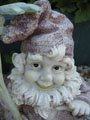
An option to planting in the ground it to use a combination of planting in stylish containers to accent the existing plants in the garden that you choose to keep. I have seen some gorgeous combinations! You can even add a small water feature to greet visitors to your home. This is a good time to add in a few solar powered accent lights as well. Don't forget a gnome or two for good gardening luck!
Happy Gardening!
Garden Gnome
©2006-2011
Happy Gardening!
Garden Gnome
Friday, September 30, 2011
Dealing With Mature Landscaping
Friday, August 21, 2009
Crabapple Tree
It can be both frustrating and fascinating when you move into a home where you haven't planted the vegetation. In some cases recognizing the vegetation is quite easy but in other cases you may not know what is planted where until you do careful observation beginning in the spring. This is the situation we found ourselves in since moving here in 2007.
Crabapple Blossoms
We have three gorgeous flowering trees on our property. One is still unidentified, one is what we think is a flowering dogwood and one is a crabapple (Malus). Malus is a genus of about 35 small deciduous trees in the Rosaceae family. In most cases crabapple trees are grown for ornamental purposes. They put on a very pretty spring display of delicate blossom colour. Crabapples range in blossom colours from white to a deep almost fuschia pink. The flowers are 5 petals appearing in late April or early May.
Our crabapple tree is about 6 foot tall and spans about an 8' diameter. In the spring it puts on a showy display of white blooms with pale pink tinges. Once the blossoms are gone the tree is rather non-descript until the crabapples appear. These miniature, very sour apples are edible for both humans and birds.
Crabapples
The fruit of the crabapple tree ranges from bright red to redish yellow to yellow depending on the variety. It is quite small depending on the variety ranging about the size of a marble perhaps a bit bigger. The fruit should be harvested when it becomes red or ripe looking if it is a yellow variety. Signs of ripening are fallen fruit on the ground. However, if you leave the fruit to ripen to this point it is quite often infested with small worms making it useless for human consumption. So pick the fruit when there is a blush on the fruit but it is not fully red.
Our crabapples are pretty much ready for picking. I will pick enough to make a couple of batches of crabapple jelly then leave the rest for the birds. At the same time I'm a bit concerned that there appears to be a bit of yellowing on the leaves. I think it may be fungal but am fully not certain as it could be a side effect of our inclimate weather this year. At any rate, I will be picking the fruit and spraying with a foliar chamomile solution just in case.
Up Close
The crabapples themselves are extremely sour although some have been known to enjoy eating them raw. When cut in half, crabapples look very much like miniature apples. The seeds resemble apple seeds as well. The leaves are a deeper green, elongated oval shape with opposing veins, smooth on the underside. They fall from the tree in early autumn.
One of the best uses for crabapples is crabapple jelly. If you are not making crabapple jelly clean up any fallen fruits from the ground and leave the rest on the tree for the birds. Fruit left on the tree will last though a good portion of the winter if the birds don't get it first. Small animals such as rodents and squirrels will enjoy any fallen fruit.
Happy Gardening!
Garden Gnome
©2006-2009