Neighbours talking over the garden gate has long been a tradition. They share gardening tips, complain about the weather and pests yet are ever eager to discuss their gardens. That is what I had in mind when creating this blog. So stop by my garden gate to find out the latest happenings in my garden.

Happy Gardening!

Garden Gnome
"All my life through, the new sights of Nature made me rejoice like a child." ~ Madame Marie Curie"
Showing posts with label wildlife. Show all posts

Saturday, August 03, 2013

Snakes in Ontario

Regardless of where you live, you will encounter some type of wildlife.  Unless you garden on a roof top or balcony, there is a very good chance you may run into a snake.  Snakes are either venomous or non-venomous.  Some snakes are more aggressive than others but for the most part if they are left alone, they will not bother you.  In fact, some snakes like the black racer and garter snakes are quite beneficial in the garden and around the house because they prey on mice that would otherwise cause problems in your house. 

We live in beautiful Ontario, Canada which is home to 15 species of snakes.  They are the: Eastern fox, Eastern Massassauga, Northern ring neck, Northern red-bellied, Northern brown, Eastern garter, Eastern ribbon, smooth green, Eastern hognose, milk, Northern water, black rat, queen, Buttler's garter (threatened), and blue racer (found only on Peelee Island).   The only venomous snake is the Mississauga rattlesnake, a norther species we have encountered on several occasions when camping in the Bruce Peninsula area.   In our little corner of Ontario, the most common snakes a home garden would encounter is the garter and milk snake.  If near the water, Northern water snakes are fairly common.  Here is a short video of the snakes in Ontario.


I recently wrote about our encounter with a garter snake. A garter snake is rather harmless . While a garter snake is not usually aggressive, it can be temperamental. Garter snakes feed on mice, toads, insects, earth worms and other snakes. In our particular case, there is a small tract of farmland behind our property that has been a haven for mice so we have had that problem. Excessive rains causing flooding in May and June basically drove the mice closer to our house which is on higher ground. That meant their predator, the garter snake came with them.  The snake population has increased if the decreased sound of crickets is any indication.   A garter snake hanging out around the gardens is not a problem for us but I don't want it in the house.  Seeing where it fled to under the siding of course gave me immediate flashes of the snake getting into the attic or main part of the house.

Snakes can and do get into the house, generally through the very same gaps that let their prey (eg. mice) into the house.  Some snakes like the black rat snake are good climbers and have been known to get into attics via overhanging tree branches.  Snakes are legally protected in Ontario under the Species at Risk Act and Endangered Species Act so cannot be killed, harmed, harassed or captured (removed from the wild and that includes your yard).  They can be removed from your home or outbuildings and released back into the wild.  It is also illegal to destroy a snake's natural habitat but you can remove woodpiles and brush from your property to make it less favourable as a habitat for snakes.  Signs of snakes around or in the house are: actual sightings, scat (usually white), shedded skin and if indoors you may notice a reptile odour.  There are several things you can do to encourage a snake to stay out of your house.
  • Seal all cracks and crevices in your home.  Pay particular attention to points of entry for utility services.  Snakes are nocturnal so if possible seal any hole you suspect a snake is getting into the house at after dark when it is more likely to be out hunting.
  • Secure windows and doors.  Snakes, rodents and other pests can enter the house through opened screened doors and windows.  The snake in question was about 2 feet from our front screen door so had I opened it as it was scurrying away from my husband, it could easily have slipped right past me into the house!  Open patio doors are prime entry points for a variety of pests that can enter the house in a blink of an eye.  Keep screen doors and windows in good repair not only the screening material but also ensure there are no gaps where snakes or their prey could get in.   Replace the weatherstripping to be sure.
  • Deterrents - Powdered sulfur and mothballs have both been shown effective at deterring snakes.  Remove woodpiles or place them as far as possible from the house.  Remove heavy brush.  Keep grass cut and trimmed.  Remove or cut back heavy vegetation growth around the foundation of your house.  Trim tree branches overhanging your house especially if you live in an area with snakes prone to climbing.  Remove any standing water.  Birdbaths should be up off the ground so as to not encourage snakes.  Snakes like wood mulch.  Replace with stone or remove entirely. 
  • Barriers - Some barriers are effective against snakes.  In general, snakes can't climb stairs because of the 90 degree angle so it is less likely a snake will get onto your raised deck or in raised garden beds. Some fences (eg. solid, fine mesh) may keep snakes out. 
  • Introduce a predator - Cats and hawks are both snake predators.  If your neighbours have cats and you have snakes or mice, chances are very good their cats will be frequenting your yard providing they are mousers.  Don't discourage the cats.  They will soon drive away both snakes and mice!  If there are no neighbourhood cats, you can always get a cat.  I recommend a farm cat as there is a higher chance it will be a mouser but no guarantee.  With a bit of effort you can attract birds of prey like a Sharp Shinned Hawk that will frequent your yard if you feed the smaller song birds.  While they are after birds they also prey on mice, voles, baby rabbits and snakes without harming your gardens or becoming pests.  So they can be quite beneficial at pest control.
  • Eliminate it's prey.  Mice will attract snakes.  Discourage mice by removing their food source (eg. bird seed) and habitat (eg. wood piles, brush).  This will encourage mice to move onto greener pastures.  Get rid of mice by using a pest control service, trapping or scatter rodent bait around your property to kill them off. 


Thursday, July 25, 2013

Still Here...

No I have not dropped off the face of the earth or even given up gardening.  After an abnormally cold spring and spending the month of May at our vacation home in the sunny south, we made the decision to do a bit of major work on the outside of the house.  That meant a lot of ripping out some of which is still in progress.  We are now in the progress of working on the front and side garden beds that were taken down to the bare earth.  The line locates have just been completed so we are ready to start actual construction this weekend.

Our house is in an urban subdivision.  There is a small piece of land behind our road that is owned by the municipality.  It is slated for subdivision development but is currently being farmed so we have farmland behind our property.  It really isn't much as we could easily walk from the back of our property to the edge of the houses on the other side of the field in 5 minutes or less.  On the far edge just before the houses are the railroad tracks so even with development which at this point looks rather unlikely, so there would always be a strip of land conducive to wildlife.  In all likelihood, if this land were ever developed, the larger portion of it to the west would have housing but the portion right behind us and our neighbours to the east would likely be turned into parkland as it is too narrow for housing plus access. 
 

garter snake making its way behind our siding trim at the front of our house
At any rate, this farmland brings a few wild critters with it.  About a week ago we noticed a rather large piece of snake skin while cutting the grass.  This morning my husband spotted a large garter snake directly in front of our road facing, lower level window.  His movement scared the snake which retreated into the space between the siding trim and the front step.  We were not impressed!  A quick  online search revealed that moth balls repel snakes so he bought two boxes and we tossed them around the foundation as a temporary measure.  I don't like using moth balls because they are toxic and generally are only effective as a short term measure.  We are laying the weed barrier and rock in that area on Saturday so hopefully the snake will move along before then.

I called our pest control service who had dealt with our rodent problem.  Rodents will always be a problem on our property due to the field but we have taken all the necessary steps to prevent them from getting indoors.  Our recent work outdoors has disturbed pretty much most of our property and it is only going to get worse over the next few weeks with the construction.  That means any wildlife habitat in our yard is going to be disturbed so we will be seeing a few more critters.  According to our pest control service most snakes in Ontario are protected so you can't harm or kill them.  He said the moth balls and ammonia, another popular repellant won't work.  He said to just wait until the snake comes out then caulk where it went up into the siding.  Garter snakes are fairly harmless, non-aggressive snakes that may bite if provoked but in all reality, this snake will really help keep rodents in check.  I just don't want him making his home behind our siding or worse getting into our home.

I found a good site with advice on getting rid of garter snakes.  Under the remove what they like, we basically have been doing that as far as the thick growth and tall grass.  We don't have any bird feeders, wood piles or ground level water.  The small east garden bed is volunteer poppies while the rest (front and west side) has been leveled to the bare ground and will be covered with rock this weekend with likely no plantings until fall if then.  Along the back fence became a bit over grown the past couple of weeks so we cleared most of that this morning.  The entire backyard when finished will be decking and pool with the exception of the raised beds for herbs and vegetables.  Those beds will take up a total of about 10' x 20' and consist of the beds with rock paths.  As a raised bed garden goes this will end up being one of my smallest gardens yet.  I do have big plans for container gardening on the decks and have already started along those lines.  In short, upon completion the entire property will not be very attractive to the rabbits and snakes. 


Thursday, February 03, 2011

The Crows Visit

crow
The Crow
January 31, 2011

Crows are large nuisance birds that cost local farmers hundreds of thousands of dollars annually.  In urban settings they are such a nuisance that some folks have taken to shooting them with pellet guns.  Home gardeners can also have problems with crows.  Regardless where you live, crows can be a huge problem with getting into garbage bags set out for collection.  They can make quite the mess!

We are rural on waterfront property so luckily the crows tend to be more of a nuisance for the farmland across from rather than bother us much.  Recently a flock of crows have been visiting our large maple trees where they forage around the base of the trees.  The snow isn't quite as deep there.  They fly between the open water back to the trees, down to forage then repeat.  While crows don't land on the water they can get water by standing on the ice.  The crows are rather aggressive towards the smaller waterfowl but tend to behave themselves when the swans are around.

Happy Gardening!

Garden Gnome
©2006-2011


Wednesday, April 21, 2010

Our Resident Bluejays

blue jays

We have a pair of resident bluejays that frequently visit a couple of times a day.  Their antics can be quite amusing!  I toss out unshelled peanuts for them to enjoy so if I haven't put the peanuts out by the time they arrive they will come close to the house and call to get my attention.  Once in awhile a squirrel tries to sneak a peanut but the bluejays are onto him.  They chase him away every time, poor guy. 

Happy Gardening!

Garden Gnome
©2006-2010


Thursday, April 01, 2010

The Mallard Family Visits

I am certainly going to miss the visiting wildlife here when we move. Oh sure we will still have visiting jackrabbits, skunks, raccoons, the occasional opossum and many song birds, we won't have the visiting waterfowl. Over the past several years while living on the water we have come to think of the visiting waterfowl almost as pets. We ensure their habitats are kept to their liking to encourage their return and just like song birds we feed them. The swans and mallards bring their babies back to visit us pretty much daily so they really do consider our home their home.

Mallard drake with henMallard Drake

The Mallards started visiting us shortly after we moved here in 2007. They were very timid as if trying to figure out whether we were friend or foe. They must have like us because the same pair have been visiting us ever since. In spring of 2008 they nested under our evergreens. No one was allowed near the nesting site so that meant the dock was off limits. Papa Mallard has beautiful feather colours with a gorgeous deep shiny emerald green head. He is usually around when Mommy Mallard is nearby.

He has become quite friendly even following me around when I'm near the water. He loves sitting on the dock railing just watching over his domain. This year the mallards are getting even more comfortable. Here they are playing in a low puddle in our backyard only about 10' from our house.

Mallard hen with drakeMallard Hen

The Mallard hen is ever so friendly except when on the nest. Well even then she is friendly because she knows we won't disturb it. Female mallards like most birds are drabber in colour likely an evolutional adaptation to prevent predation while nesting. Still I think she is quite pretty.

The couple enjoyed playing in puddle created by a low level in the yard that was caused by a former paved formal garden. During heavier periods of rain this low area fills ups forming a bit of a small pond. The mallards were enjoying the warmth of the sunshine while collecting a few earthworms. It really looked like they were enjoying themselves as much as I did taking pictures of them.

Happy Gardening!

Garden Gnome
©2006-2010


Saturday, February 27, 2010

Finally We Have Snow

tundra swan
Tundra Swan
February 22, 2010

We have had such a mild, precipitation winter this year that I have been extremely concerned as to what this will mean to our local farmers and home gardeners. Despite getting little more than a light flurry with no accumulation between November 2009 and January 2010, February gave a bit of home with now the second of two snow storms consisting of good accumulation. This is a good thing as we need the snow for spring runoff and proper moisture content for spring planting. I'm quite happy with this turn of events!

Happy Gardening!

Garden Gnome
©2006-2010


Wednesday, August 19, 2009

Garden Resident


Albino Toad Close-Up
August 15, 2009

I posted earlier on my albino toad garden visitor (more here). At that time he really liked hanging out by the garden gnomes and he still does likely because they are in the shade most of the day. For the past few days he has been hanging out in the garden as well. I think he has learned I will do him no harm as he will sit posing for pictures and he no longer hastens to jump into hiding. I talk to him as a bit of assuring him I won't hurt him so perhaps he recognizes the sound of my footsteps or voice. I think he is just adorable!

Happy Gardening!

Garden Gnome
©2006-2009


Tuesday, August 04, 2009

Another Garden Visitor


Well Hello!
July 25, 2009

Last week we had a unique visitor to the garden. Now we are used to having a lot of visitors to the garden but this is a first. Pictured is the albino toad that visited. He particularly liked hanging out with the gnomes near the side entrance. Albino toads do not survive well in nature simply because they lack the natural pigmentation that provides camouflage thus making them easy prey. This one has likely survived because not only is he nocturnal he is inhabiting our gardens that aren't lit at night. The only outdoor lighting we use is solar garden lighting so the gardens aren't brightly lit giving this little guy lots of hiding spots.

Toads should be actively encouraged in your gardens. They are ideal for controlling a vast array of insects and they don't cause any problems. Toads breath through their skin so are very susceptible to insecticides especially slug bait. If you are gardening organically which you should be your toads will be safe and enjoy their garden stay. Part of the Hippocratic Oath in medicine states "do no harm". This idealogy should be extended to gardening as well. Gardeners are stewards of the land so should seek to control pests in the least damaging method possible.

Happy Gardening!

Garden Gnome
©2006-2009


Monday, June 05, 2006

Baby Birds & Bunnies

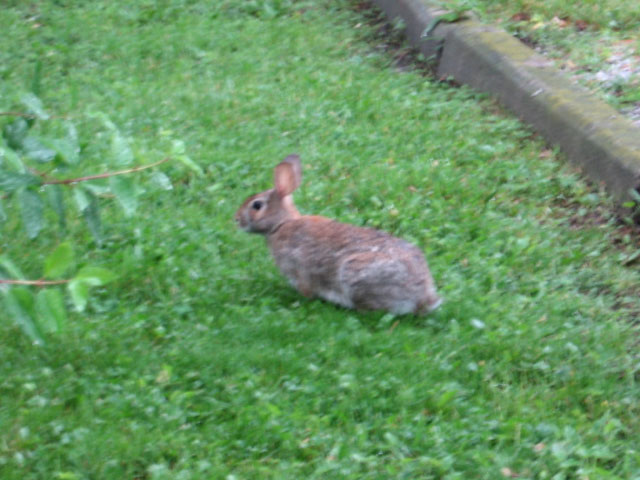
One of my first blog posts was about bunnies. We have a healthy and abundant jackrabbit population. From experience, the jackrabbit population is cyclic. Last year they never bothered with my vegetable garden or if they did, I never noticed. This year they like the garden and have quickly become a problem. Not so much "they" just one very persistant young one. Young rabbits are like teenagers - no fear and very defiant!

Rabbit

I left the greenhouse light on, left a radio playing and turned the motion activated spray to very sensitive. This little guy danced to the oldies while taking his shower and munching on salad! So I added bone/blood meal to the garden beds as apparently they don't like the smell. I can't really blame them! I also added a large plastic owl to the bed the rabbit seems to prefer.

Plastic Owl

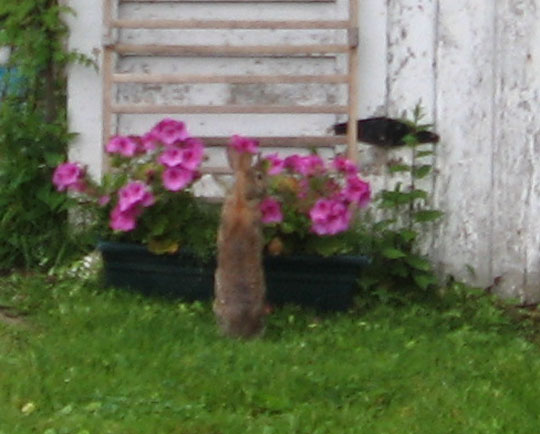
So far so good in the vegetable garden. But yesterday I looked out and what did I see - the young one and either a friend or family member! They were "in" the window box planter on the ground planted with Martha Stewart geraniums.

Rabbit in Windowbox

Apparently they like safflower seed even though they aren't supposed to like it and they thought the window box was a perfect stool for them to sit on. I liberally applied cayenne/powdered pepper mix to which they thanked me and asked for more. My luck they will make friends with the owl and get him dancing to the oldies as well. Heaven help me if they discover the slugs' beer. I give up!

We are fencing the vegetable gardens keep the rabbits out. The original vegetable bed has a gravelled holding path and area for hardening off plants. The greenhouse is in the corner of this area followed by three raised beds perpendicular to the greenhouse and two raised beds perpendicular to the three beds forming a large rounded on one corner gardening area. I really like the design and flow of the garden. We decided to add three 4' x 4' beds that originally were going to sit along the side of the garage. Now, my husband thinks it would be best to align them along the holding path creating a regular path there and adding a new holding bed so the greenhouse will be sitting about a third of the way into the garden with raised beds on both sides. He thinks it will be easier to fence. The boxes have been constructed for awhile so it is only a matter of adding soil later today. We'll remove the border rocks then extend the paths to the west. I intend to put in a small gated arbour then 3'rabbit proof fencing along with a 8" wide raised bed running along the entire perimeter to be planted with marigolds. So another year of gardening additions begins!

During the spring I watched a pair of robbins build a nest in our maple tree so I wasn't surprised to see part of a robbin eggshell under the tree.

Robbin's egg

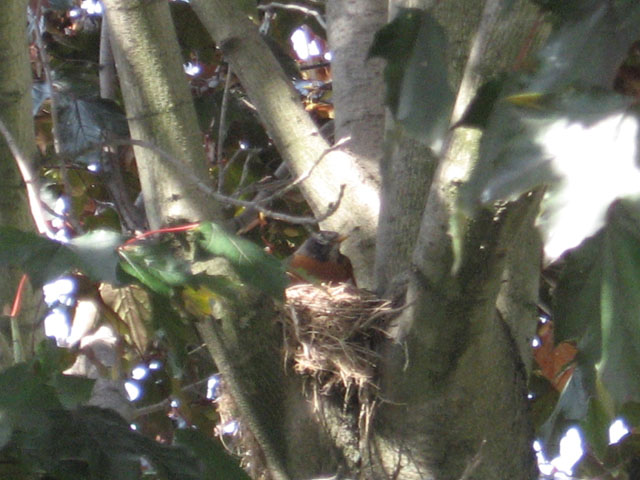
My husband had been planning to trim the tree but agreed to leave it be until the babies left the nest. I had the advantage of being able to view the nest from one of our front windows. Both parents were very agressive towards other birds to the point I had to stop feeding the bluejays peanuts.

Robbin on Nest

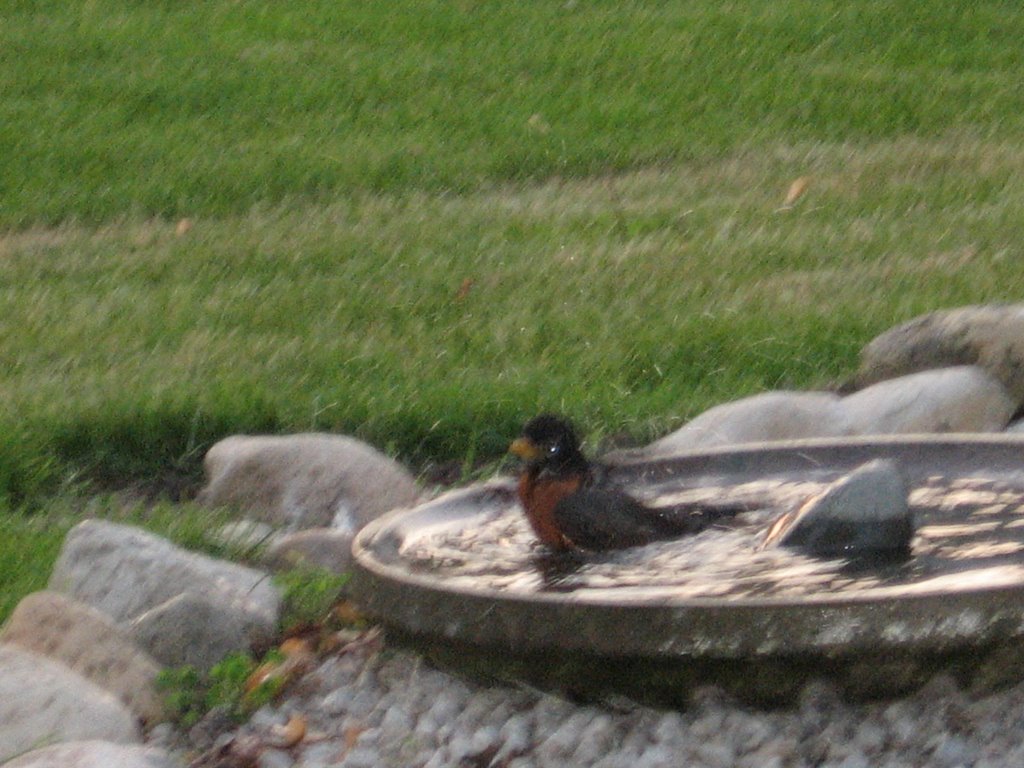
They even went after the squirrels! For some reason they didn't attack the sparrows likely because they didn't see them as threat. The male robbin likes to follow me around when I water the garden and he will let me get quite close to him. It is a rather funny sight so I've been told. He stays about four feet behind me the entire time I'm watering. Both robbin parents really appreciate the garden bird bath. They are regular visitors in the garden and despite other reports that robbins can do tomato damage, I have yet a problem with robbins.

Robbin in Birdbath

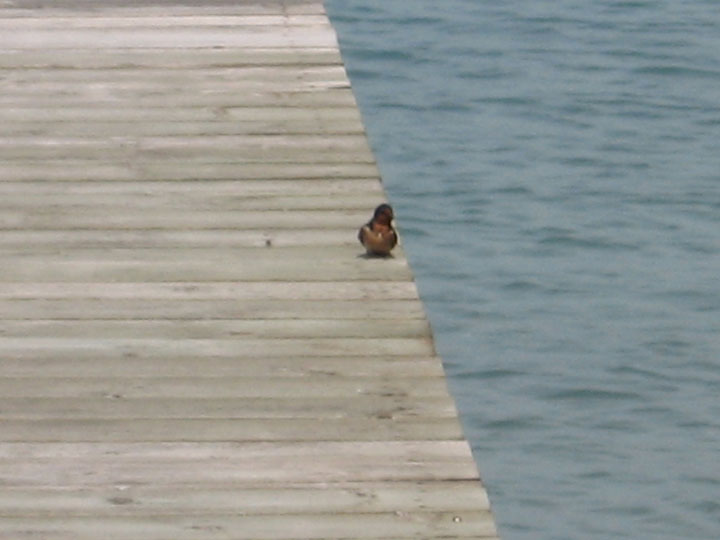
We have swallows on our dock. When they are nesting they create a real problem by swooping low towards your head usually three or four at a time. This basically makes the dock unusable for about a month so a lot of people use plastic owls to prevent them from building a nest in the first place. These staunch little birds stand guard allowing no one onto the dock or even near it. They will immediately take flight and swoop at your head as soon as you try to go onto the dock.

Swallow

I tried to ward them off this year by putting that same plastic owl on the deck for a morning. The swallows were so distressed I just couldn't leave it out there as there were likely babies in the nest. A couple of days later I managed to get on the dock to see that there were a couple of babies. I'm so glad I removed the owl! My neighbour says a swallow's nest brings good luck and I can use all the good luck possible.

Yesterday, I noticed the robbin's nest was very quiet. By now it is apparent the babies have flown the coop. While I'm glad they are old enough to fly I was saddened that the nest was empty. Then this morning I noticed the swallows are no longer standing guard. Their offspring must have flown the coop too.

Happy Gardening

Garden Gnome