Neighbours talking over the garden gate has long been a tradition. They share gardening tips, complain about the weather and pests yet are ever eager to discuss their gardens. That is what I had in mind when creating this blog. So stop by my garden gate to find out the latest happenings in my garden.

Happy Gardening!

Garden Gnome
"All my life through, the new sights of Nature made me rejoice like a child." ~ Madame Marie Curie"
Showing posts with label garden visitors. Show all posts

Wednesday, October 05, 2011

Unidentified Frog

frog in driveway


Unidentified Frog
September 23, 2011

For the most part I love garden visitors.  Ok, I'm not overly happy about having some pests visit but you have to take the bad with the good.  Frogs are always a welcomed visitor in my gardens both at our permanent home and vacation home.  I'm getting to know some of the garden visitors at our vacation home.  This cute little guy was enjoying our carport.  I'm not sure what he is but I think he may be a Greenhouse Frog.  

Happy Gardening!

Garden Gnome
©2006-2011


Tuesday, March 29, 2011

Finally the First Photogenic Robin of 2011

robin in maple tree

Robin in Maple Tree
March 23, 2011


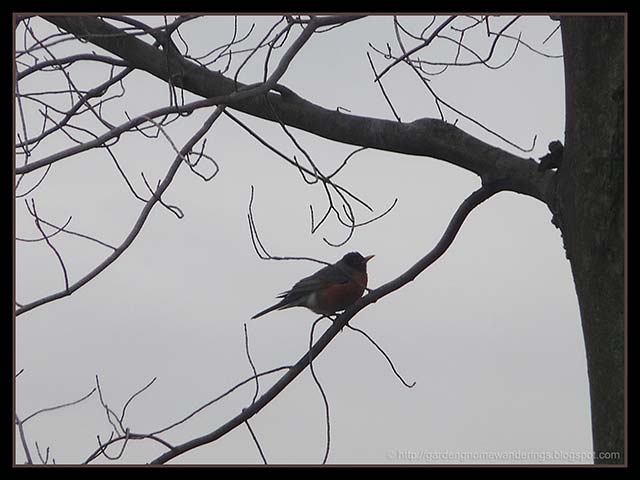
I posted earlier about spotting the first robin of the season.  For those who don't know, here in beautiful Ontario, Canada where we experience winter complete with cold temperatures, ice and snow the robins migrate to warmer locations for the winter.  I can't say as I blame them which is one reason we have joined the snowbird crowd with our vacation home in the sunny south.  Unlike the robins who are gone for about 5 months, we only go for a month at longest but still it is a break from the cold.  The return of the robins signifies the onset of spring.  Unfortunately, no one has informed Mother Nature of that yet so the poor robins are still dealing with unseasonably cold weather conditions. 

The robins are not being as co-operative for their photoshoots likely due to the cold.  I hear their cheery chips in the bushes but they are staying tucked in out of the weather.  This little guy braved the cold just long enough for me to get a couple of pictures.  His red chest is just a cheery sign of spring to come!

Happy Gardening!

Garden Gnome
©2006-2011


Wednesday, January 26, 2011

Gator Pond at Busch Gardens

gator pond
Gator Pond at Busch Gardens
December 16, 2010

When we first visited the resort where we ended up buying a vacation home I thought the cutesy warning signs about not feeding or antagonizing the alligators were meant to add a bit of humour.  By the end of that first trip in 2009 I realized the alligators were very much real.  We bought in March of 2010 but didn't see our new vacation home until May that year.  During that time period we had a lot of opportunities to see alligators in and around our resort.  Gators for the most part will ignore humans providing they haven't been feed and aren't provoked.  My husband has been rather close to a few gators on the golf course and since our resort is filled with numerous good sized ponds, gators are a very common sight.  I've  managed to get a lot of great photos and videos of gators from the safety of the golf cart and car.  Those in our community with houses backing onto these ponds have been told they should not feed the gators.  This of course brings in a whole new element to gardening especially for those homes on the ponds.  As you can see from this photo taken at Busch Gardens in Tampa, Florida alligators are rather large beasts.  The largest in our resort is about 8 feet long so that's a good sized gator.  They can out run a human running a straight line but I'm not about to test that theory out. 

Happy Gardening!

Garden Gnome
©2006-2011


Sunday, January 09, 2011

Ringneck Snake

If you have been following this blog you will know we bought a vacation home last year giving me the opportunity to garden in two very different hardiness zones.  It has meant learning about various critters that visit our southern garden.  There are venomous snakes and spiders there so it is important to identify these types of visitors to avoid possible bites.

ringneck snake
We had one of our friends and his 8 year old visiting us.  A couple of days after they left and our kids were visiting, we pulled into the driveway where I spotted what I thought was a hair band the little one had dropped.  I instinctively bent down to pick up the hair band then stopped short to take a better look.   While the hair band was still, I noticed a orangey red band.  There was a slight movement then the hair band uncurled to reveal a small!  Pictured is the baby ringneck snake sunning himself in the warmth of the sun on our driveway.  He was about 3 - inches long.

Ringneck snakes are common harmless, beneficial snakes in Florida.  They feed on earthworms, slugs, small skinks, lizards and tiny frogs.  As with any snake they may bite if cornered but it is non-toxic to people.  Ringneck snakes are sociable so they are usually found with other ringneck snakes.  They reach a length of about 2 feet at maturity.  Newly hatched ringneck snakes are prey for large spiders and centipedes.

ringneck snake defensive position
Ringneck snakes have a rather unusual defensive trait.  When disturbed the turn upside down displaying their orangy red underside upwards in a curled fashion.  It could be the orangy red colouration serves as a visual warning to predators that they may be distasteful or poisonous.  It could be just a camoflauge method for prey to trick them into thinking the snake is already dead very similar to how an opossum plays dead to avoid predation.  The ringneck snake also releases a foul-smelling odour to defend against predators.  If playing dead and the odour doesn't work the snake will viciously bite.

Happy Gardening!

Garden Gnome
©2006-2011


Sunday, October 17, 2010

A Leopard Frog Visits the Garden

leopard frog
Leopard Frog
(Rana pipiens)
October 16, 2010

Oldest and youngest grandchildren visited yesterday.  On their way to the car after our visit we stopped to check out the garden.  Imagine oldest grandchild's squeals of delight at spotting this beautiful leopard frog.  This is the first time I've seen a frog in the garden.  It sure was a pleasant surprise.

Happy Gardening!

Garden Gnome
©2006-2010


Sunday, October 10, 2010

The Spider

The Spider
October 1, 2010

If you have been following this blog you will know that I now garden in two very different hardiness zones.  My home hardiness zone is Canadian Hardiness Zone 6A but our vacation home is in US Hardiness Zone 9B.  I am learning so much about gardening in a warmer climate!  We were out doing a little yard work and discovered this huge and I do mean huge spider.  We have large funnel spiders as home but that did not prepare me for this huge spider!  It had to be about 4 times the size of a large funnel spider.  To get an idea of the size of this spider each siding strip from straight edge on the bottom to cove edge on the top is 4 - inches. The spider stretched out would span most of that 4 - inches!  Needless to say we have a healthy new respect for gardening gloves!

I should mention that I was as far as we can tell bit by something shortly after arriving.  My hand swelled horribly with a very tender lump then it turned just about every shade of purple you could imagine with my knuckles a bright red.  It took a good week for the swelling to start going down.  After three weeks the bruising is almost gone but the tender lump remains.  As long as I'm seeing signs of healing I'm not concerned but in hindsight I likely should have had it checked because if bit again by the same critter the reaction will likely be a lot worse.  As a result I have been doing a fair amount of research in what to be on the look-out for in US Zone 9B.  There definitely are a couple of venomous snakes, brown recluse spiders and fire ants to watch out for.

Happy Gardening!

Garden Gnome
©2006-2010


Saturday, October 09, 2010

The Salamander

salamander
Salamander
September 15, 2010

A couple of weeks ago we went down to the clubhouse for dinner.  Surrounding the clubhouse are lovely raised garden beds as well as traditional style.  What is really nice is they have placards with the names of many of the plants to help other residents in the community identify the plants they may want to use in their own gardens.  A cute little salamander darted about then right on cue posed for his photoshoot.  As amphibians go, salamanders are a bit more of the cute size.  I love watching the geckos too and while I enjoy photographing the alligators I am sure to keep a safe distance from them!

Happy Gardening!

Garden Gnome
©2006-2010


Thursday, June 10, 2010

At Risk Garden Visitors

As I work in the garden I am always on the look-out for garden visitors both friend and foe.  I find it amazing the diversity of critters that visit the gardens and yards.  For the most part all of the visitors are wild with the exception of a couple of neighbourhood cats that visit occasionally.  Currently the most noticeable difference in my garden visitors is the glaring absence of the wild rabbits and I have seen the cats for quite some time either.  Given our location on the water with bordering farmland I'm surprised we haven't seen any snakes either. 

baby bird
A couple of days ago I was doing a bit of planting in the garden.  Close to the sidewalk under the cedars there was a tiny bird that had fallen from it's nest.  Obviously he was in a bit of shock from his fall but did not appear to be hurt.  The fall would have been roughly about 8 feet.  This poor little one was a critter at risk in my garden especially if the neighbourhood cats happened upon him.  There are also several species of birds of prey that frequent our area.  I kept an eye on him hoping that he would be able to get to a bit safer location under a nearby shrub.  At least there he wouldn't be quite so noticeable to predators.  The following day he was gone but there were no signs of harm so I think he may still be under the shrub.

albino toad
Last year an  albino toad decided to call the gardens his home.  Toads are always most welcomed in my gardens for natural insect control.  An albino toad seldom survives long in nature because it is lacking the natural camoflage needed to protect itself from predators.  Despite that the albino toad managed to spend the gardening season with us. 

My husband was unloading the car from our vacation when he discovered the albino toad again.  He told me the yellow toad was back if I wanted to get pictures.  Sure enough there was the little critter waiting patiently with the gnomes for his photoshoot.  This reminds me I need to make a couple of toad homes to give him a bit more protections.

Happy Gardening!

Garden Gnome
©2006-2010


Sunday, May 09, 2010

An Early Evening Garden Visitor

We are very fortunate to live in a rural area with an abundance of wildlife.  Our house backs onto the water so there is an amazing variety of waterfowl throughout the year.  There are two pairs of Mallard ducks nesting on our property this year and Mute Swans visit daily.  Although some of the wildlife we encounter such as mice are not quite welcomed for the most part the wildlife tends to be mainly an enjoyment mixed with a little pest behaviour at times.

A couple of nights ago just after dinner as dusk was falling my husband spotted a garden visitor.  This friendly little fellow was on the stairwell landing looking straight into our patio doors.  Obviously the smells from dinner had attracted him as he was about 10 feet diagonally from the patio door.   The picture was taken through the patio door.

We knew that there were raccoons (Procyon lotor) in our area.  We've heard their chatter and had seen tracks in our yards.  What surprised me is until this little guy appeared we had not actually seen them.  Isn't he just adorable?  To the right there is Lily of the Valley is now in bloom.

We have a fair amount of experience with raccoons being seasoned campers.  Raccoons can be problematic because they love to raid garbage pails.  It is surprising how they can get into picnic coolers and garbage pails with little effort.  A few days before the raccoon visit I had set a bag of garbage on the patio with the intentions of asking my husband to put it in the garage when he got home.  I forgot so was greeted to the bag being ripped open and a mess to clean up.  I wasn't sure what had got into the bag but from experience even grackles and crows will peck open a bag of garbage.  Now I think it might have been the raccoon and since raccoons are smart little critters he likely came back to see if I forgot again.  Raccoons, skunks, ermines and possums are a bit more problematic for us given the design of our house.

Our house is tucked into a sloped bank with the water edge considerably lower than the street edge.  It is a two level house but in reality three level with upper level above ground, entrance level almost on the ground and lower level mainly below ground.  The kitchen is on the lower level.  Pictured is the kitchen looking in from the great room.  The window is about 4 - inches from the ground.  To the right is the start of the patio door entrance that leads to a covered patio with screen-in sunporch above it.  This presents a problem.

Garden visitors especially larger ones like raccoons can easily get through the window or patio door if determined enough.  There is no way we can get to either window or patio door to shut the glass panes if the visitor is a skunk as I found out last summer.  A skunk was sniffing around the patio screen door.  It was a beautiful night so I was enjoying the fresh air while watching tv when the skunk appeared.  I used an old camping trick of shining a flashlight into his eyes then held my breath as he mosied on without spraying.  We take the precautions of not leaving food out on the counters and cleaning up immediately after meals so as to not encourage the possibility of attracting critters to the window and door.  We also pull the glass panes to where they are open by about 4 inches to let air in but not critters.

Happy Gardening!

Garden Gnome
©2006-2010


Friday, April 02, 2010

Found in the Garden

rabbit bones
Rabbit Bones
April 1, 2010

There are many visitors to my gardens but sometimes I only see the tell tale signs they were there not the animal or bird itself. We have a fair number of hawks as well as a couple of neighbourhood cats that are of course predators. Every once in awhile we find the carcass of a small animal or bird. This morning when I was out checking the garden I spotted the remains of a jack rabbit. We have a lot of them in the area so it is common to see several in any given day. This one did not make it through the winter.

Happy Gardening!

Garden Gnome
©2006-2010


Tuesday, November 17, 2009

Garden Visitor


Garden Visitor
November 7, 2009

This little guy visited us earlier in the month. He was a bit sluggish so I moved him off the path. Autumn has been rather mild and for the most part drier than the spring and summer. There isn't much left to do in the garden and yard other than the last minute tidying. We've cleaned the beds from debris and most of the leaves have been raked up from the yard. One tree is still dropping leaves so it will be awhile yet before we can clear up all the leaves. At any rate we are getting things ready for the cold weather that will hit any time now. It's time to get on the seed catalogue lists for 2010.

Happy Gardening!

Garden Gnome
©2006-2009


Thursday, April 16, 2009

Mourning Doves (Zenaida macroura)

Mourning Dove
Mourning Dove
(Zenaida macroura)
March 26, 2009

Mourning doves (Zenaida macroura) visited the kids' garden providing on ground clean-up below the bird feeder. Now I have a love/hate relationship with these birds. In reality they are rather beneficial birds in the garden as they eat almost exclusively seeds but in a pinch will eat insects and snails. They provide the clean-up crew under bird feeders which discourages rodents. So all the way around the mourning dove with it's soft, subtle coo-coo call is a beneficial bird in your garden. However, mourning doves are cousins to pigeons so they can be somewhat messy although I find they aren't near as messy as pigeons. I welcome these birds into my garden because for the most part they are rather well behaved, beneficial birds.

Happy Gardening!

Garden Gnome
©2006-2009


Wednesday, April 15, 2009

Eastern Chipmunk - Genus Tamias

Easter chipmunk
Eastern Chipmunk
March 25, 2009

The Eastern chipmunk is a member of the rodentia family and like all members have long front teeth for gnawing. They mate in the spring and again in the summer. One pair can produce 8 to 10 offspring per year. Our family is well acquainted with the Eastern chipmunk with most of that experienced gained though a couple of decades of camping. These cute little critters scurry about campsites hoping to get a glimmer of food from campers and in fact despite being told not to, many campers still feed chipmunks. Around campsites and even homes they will become rather friendly. To date I have seen absolutely no reason not to encourage chipmunks in the yard but at the same time even being in a rural area chipmunks have never frequented my gardens. They provide marvelous clean-up under bird feeders and the worst I've seen is a bit of light digging looking for food at the home of oldest grandbaby. However, from camping experience I do know they burrow so that could be a problem in the garden. I also know they are rather partial to most vegetables and although they do prefer grains they also eat insects, birds eggs, nuts, small frogs, fungi and worms. In the big picture a resident chipmunk family can be both a good thing and a bad thing from a gardening perspective. Aside of burrowing which really does aerate the garden, they transfer seeds and spores while providing a free clean-up service. Essentially this is an eco-friendly rodent you want in your garden.

Happy Gardening!

Garden Gnome
©2006-2009


Tuesday, April 14, 2009

Red-winged Blackbird (Agelaius phoeniceus)


Red-winged Blackbird
(Agelaius phoeniceus)
March 22, 2009

I recently spent a couple of weeks at the home of oldest grandbaby so managed to get a few pictures of their garden visitors. Everyday a few Red-winged blackbirds (Agelaius phoeniceus) would visit the feeders. Red-winged blackbirds are members of the passerine family. Males display the bright red wing band while the females are a rather nondescript dark brown. They are quite prevalent in southwestern Ontario and in fact many farmers and gardeners view them as being pest birds. It was rather interesting seeing them at feeders in the Greater Toronto Area (GTA).

Red-winged blackbirds feed on both grain and insects so they can be beneficial to attract to home gardens providing you are not growing any grains. They can help keep insect populations in check. However, cash crop grain growers must discourage them in our area and usually this means sound deterrents that sound intermittently to scare off the grain feeders. I cannot say whether this method is affective as birds do become acclimatized to this type of thing. In home gardens the best bet is to use bird cloth to prevent red-winged blackbirds of stripping your grain crops.

In our general rural area we do have a lot of red-winged blackbirds but they seldom venture to our bird feeders. Surprisingly they don't even seem to bother the gardens but that could be due to them being well fed by the surround fields. I think they are a very pretty bird and they do have a rather pleasant song. So if you see these birds in your garden, welcome them. Protect any grain crops then enjoy their beauty.

Happy Gardening!

Garden Gnome
©2006-2009


Tuesday, March 11, 2008

Garden Visitor


Buggs
March 10, 2008

Mr Buggs is a rather persistent visitor to my new gardens and visited often last year. He tucks up under the bushes and the lilac tree to watch what is going on in the house. I can tell he is already smacking his lips in anticipation while watching me pour through the seed catalogues. Last year's visits were not so much of a problem as we moved too late for a vegetable garden. He did a bit of damage in the flower gardens but not too much. Mr Buggs will be a problem for the new vegetable beds so I'm already planning on deterrent measures.

From past experience, rabbits may or may not be deterred by cayenne pepper. Noise makes sometimes work. Motion activated sprayers work if you move them around and they were very effective in our previous gardens. However, here the vegetable and herb gardens are going to be scattered over the property and tucked in where I can fit them so it won't be a "all in one spot" design. The thing I've learned when dealing with pests like rabbits is to use more than one deterrent. Mr Buggs is already trying to figure out what I'm up to. I think I will just keep him waiting.

Happy Gardening!

Garden Gnome
©2007