Neighbours talking over the garden gate has long been a tradition. They share gardening tips, complain about the weather and pests yet are ever eager to discuss their gardens. That is what I had in mind when creating this blog. So stop by my garden gate to find out the latest happenings in my garden.

Happy Gardening!

Garden Gnome
"All my life through, the new sights of Nature made me rejoice like a child." ~ Madame Marie Curie"
Showing posts with label pests. Show all posts

Sunday, May 09, 2010

An Early Evening Garden Visitor

We are very fortunate to live in a rural area with an abundance of wildlife.  Our house backs onto the water so there is an amazing variety of waterfowl throughout the year.  There are two pairs of Mallard ducks nesting on our property this year and Mute Swans visit daily.  Although some of the wildlife we encounter such as mice are not quite welcomed for the most part the wildlife tends to be mainly an enjoyment mixed with a little pest behaviour at times.

A couple of nights ago just after dinner as dusk was falling my husband spotted a garden visitor.  This friendly little fellow was on the stairwell landing looking straight into our patio doors.  Obviously the smells from dinner had attracted him as he was about 10 feet diagonally from the patio door.   The picture was taken through the patio door.

We knew that there were raccoons (Procyon lotor) in our area.  We've heard their chatter and had seen tracks in our yards.  What surprised me is until this little guy appeared we had not actually seen them.  Isn't he just adorable?  To the right there is Lily of the Valley is now in bloom.

We have a fair amount of experience with raccoons being seasoned campers.  Raccoons can be problematic because they love to raid garbage pails.  It is surprising how they can get into picnic coolers and garbage pails with little effort.  A few days before the raccoon visit I had set a bag of garbage on the patio with the intentions of asking my husband to put it in the garage when he got home.  I forgot so was greeted to the bag being ripped open and a mess to clean up.  I wasn't sure what had got into the bag but from experience even grackles and crows will peck open a bag of garbage.  Now I think it might have been the raccoon and since raccoons are smart little critters he likely came back to see if I forgot again.  Raccoons, skunks, ermines and possums are a bit more problematic for us given the design of our house.

Our house is tucked into a sloped bank with the water edge considerably lower than the street edge.  It is a two level house but in reality three level with upper level above ground, entrance level almost on the ground and lower level mainly below ground.  The kitchen is on the lower level.  Pictured is the kitchen looking in from the great room.  The window is about 4 - inches from the ground.  To the right is the start of the patio door entrance that leads to a covered patio with screen-in sunporch above it.  This presents a problem.

Garden visitors especially larger ones like raccoons can easily get through the window or patio door if determined enough.  There is no way we can get to either window or patio door to shut the glass panes if the visitor is a skunk as I found out last summer.  A skunk was sniffing around the patio screen door.  It was a beautiful night so I was enjoying the fresh air while watching tv when the skunk appeared.  I used an old camping trick of shining a flashlight into his eyes then held my breath as he mosied on without spraying.  We take the precautions of not leaving food out on the counters and cleaning up immediately after meals so as to not encourage the possibility of attracting critters to the window and door.  We also pull the glass panes to where they are open by about 4 inches to let air in but not critters.

Happy Gardening!

Garden Gnome
©2006-2010


Sunday, March 28, 2010

Controlling Bugs

While the weather is still cool soon it will be time to consider insect control for those pesky insects like mosquitoes and the damaging insects in the garden. In many urban residential areas folks turn to using an electric bug zapper. The premise is the insects are drawn towards the light then are electrocuted effectively serving as insect control. However, bug zappers are one of the worst things you can use for controlling insects in your yard or garden. Why? Bug zappers simply are not an eco-friendly approach to insect management.

  1. The light from bug zappers actually draw more bugs to it than you would normally have.
  2. Bug zappers use electricity the entire time they are on. When every kWh counts they are a wasteful use of electricity.
  3. Bug zappers do not discriminate between beneficial and harmful insects. In one evening they can easily kill off a number of beneficial insects. In one single evening a bug zapper can lure and kill 10,000 insects, most of them not damaging insects.
  4. Despite the claims and the reason many people use bug zappers, mosquitoes are not attracted to the ultraviolet lit used in these devices.
  5. Most people will leave bug zappers running all night. This has to be one of the most annoying aspects of these lamps especially if you like to sleep with an open window but instead of hearing the wonderful night sounds all you hear is the zitz, zap, zitz from your neighbour's bug zapper.
  6. Bug zappers are ineffective. Sure they kill bugs when on but they offer no permanent or effective solution.
  7. Bug zappers are ineffective during daylight hours making them a poor choice for protecting a garden or yard against insects that do their damage during full daylight, dawn and dusk.
  8. Bug zappers reduce the food source for natural predators such as centipedes, spiders, bats and insect eating birds like Purple Martins.
  9. Bug zappers disrupt the disrupt the natural biodiversity of your yard creating the potential for further insect problems by reducing natural insect predators.
  10. Bug zappers cost in the $40 or more range, cost in terms of maintenance and electricity use all of which can be avoided by using natural insect control methods.

Happy Gardening!

Garden Gnome
©2006-2010


Thursday, August 27, 2009

Today in My Garden

I was anxious to get out and check the garden today after a day and half of rain. The garden weathered the rainy weather well with only a couple of the Sweet Millions tomatoes splitting. Given the amount of rain that fell I was quite surprised. There were a few tomatoes, peppers and peas ready for picking as well.

In recent years there has been a lot of talk about the decreased levels of bees, an important pollinator. I am pleased to report that both honey and bumble bees are visiting my vegetable beds. I would love to see a few parasitic wasps that would help control the tomato hornworms. While we have a generous population of yellow jackets and hornets I haven't spotted any parasitic wasps yet but when I do they will be quite welcomed in my garden.

little marvel peasLittle Marvel Peas

My Little Marvel peas are now growing nicely and producing well unlike the Lincoln (Homesteader) peas. Although I like both varieties of peas, I tend to favour the Little Marvel as they have been consistently good performers for me. Little Marvel peas have 7 to 8 very sweet, tender peas per pod that are ideal for freezing. Unfortunately I have seldom grown enough of them to put up but we enjoy them fresh during the growing season. They are lovely tossed into salads raw.

I added a second planting of both varieties of peas for another week along with snowpeas and Laxton's Progress. I may or may not get anything off the second plantings depending on how the fall weather is.

tomato hornwormsMore Hornworms

I didn't check the garden yesterday due to the steady rain so imagine my horror when I checked it this morning to find more tomato hornworms pictured here (more here)! I could not believe my eyes as one after another were spotted. I removed seven in total. The largest one was a good 4-inches long! Once you spot hornworms as mentioned in my previous post the only thing you can do is damage control. The first round of damage control comes from the manual removal of all tomato hornworms. The second round of damage control is using some form of tilling a couple of times in the fall to destroy the pupae to prevent re-infestation in the spring.

Today I checked tomato vines several times. Aside of the initial removal of the 7 hornworms I did not spot any more. Now from experience I know that certain critters are more active at certain times of the day. Every hornworm I spotted was on the upper most stems of the tomato vines and it was late morning. So I'm now checking hourly for tomorrow, several times on Saturday then at least 4 times on Sunday to establish a pattern of when the hornworms are most active for easy removal.

fresh garden produceToday's Bounty

Today's bounty included 8 Heinz 1439 tomatoes (more here), about a half pint of Sweet Millions tomatoes, a handful of Little Marvel peas and both sweet banana and Hungarian wax peppers. Not shown is the lettuce and herbs picked for fresh use for dinner. I really like to pick both lettuce and herbs within minutes of using. At the moment it is not a huge daily harvest but it is still a harvest so I'm quite pleased.

The Habanero peppers are doing great with lots of still green peppers. The low tomato producers so far this year look to be the Lemon Boy and Sweet 100's even though the vine growth looks wonderful. All of the herbs are exceeding expectation with the exception of dill which really only produced a few heads that quickly went to seed but at least I got the dill seed from them. Other than that the garden appears to be on course for this time of year.

Happy Gardening!

Garden Gnome
©2006-2009


Sunday, August 23, 2009

Tomato Hornworm

There have been several reports of late blight hitting tomato plants in the northeastern US states. Some home gardeners have reported late blight within 100 km of us as well so I have been on high alert watching for any signs. I am be especially careful to remove any damaged vegetation from both the plants and soil level. While I have had minor damage due to the storms that went through so far there have been no signs of late blight.

tomato hornwormTomato Hornworm

This morning as I did my regular tomato vine inspection I noticed what at first appeared to be leaf damage. On closer inspection it turned out to be a tomato hornworm Manduca quinquemaculata (Lepidoptera: Sphingidae). Another check through the vines found another one. This pest is common the the northern US states and southern portions of Canadian provinces. Despite it's rather menacing appearance, the hornworm will not bite you. It feeds only on solanaceous plants, usually the tomato. However the larvae will also feed on eggplant, pepper and potato plants so be sure to check these plants as well.

The adult moth is sometimes referred to as a "sphinx", "hawk", or "hummingbird" moth. This is a large, heavy-bodied moth with narrow front wings and a wing spread of 4 to 5 inches . The moth is a mottled gray-brown color with yellow spots on the sides of the abdomen . The eggs of the tomato hornworm are deposited singly on both the lower and upper surface of leaves in late spring. They oval, smooth, light green to yellow in color measuring 0.10 cm in diameter. They hatch in six to eight days.

Tomato hornworm larvae are pale green with white and black markings. They undergo 5-6 instars. The first instar is yellow to white in color with no markings while other instars develop eight white, lateral V-shaped marks. A black projection or "horn" on the last abdominal segment furthest from the mouth gives the caterpillar the name hornworm. The caterpillar reaches the final instar in 3-4 weeks. It is about 4 inches long when fully mature. The fully-grown larvae then drop off of the plants and burrow into the soil to pupate. During the summer months, moths will emerge from pupae in about 2 weeks. When the moths emerge from the soil they mate, and deposit the eggs of the next generation on tomato plants. By early fall, the pupae remain in the soil where the overwinter emerge as a moth the following spring.

tomato hornworm damageTomato Hornworm Damage

Tomato plants should be checked for hornworms from early July to late August. Unless you see the tomato hornworm you will likely blame missing leaves and stems on tomato plants on rabbits or possibly the wind. On closer inspection you will note that the damage is likely well out of reach of rabbits and lacks the sharp angled cut. The leaves will have been completely eaten away leaving only the secondary stem (red arrow). If you look even closer below the damage on other branches you will see dark green or black droppings and in fact you will likely see these before you see the actual hornworm. Carefully look above the area where you see the droppings. It may take a bit of looking as the hornworm blends in nicely with the tomato foliage. Once you find the hornworm the best way to remove it is to hold a bucket under it then clip the stem of the leaf it is on so damaged leaf, stem and hornworm falls into the bucket. If you find a hornworm that appears to have a lot of white elongated eggs on it, leave it alone. Do not remove it! These are the cocoons of a small braconid wasp, Cotesia congregatus. These parasitic wasps will kill off that hornworm then seek out other hornworms to parasitize. Another important natural enemy is the wasp, Polistes spp. (Hymenoptera: Vespidae) that kills and feeds upon a large proportion of the tomato hornworm larvae. It will also attack cabbage looper and other garden caterpillars. Attracting both wasps to your garden is is a good form of natural pest control that should be enouraged.

Check your plants daily for any further signs of infestation. Controlling the larvae by manual removal before they burrow into the ground will lessen or prevent re-infestation in the spring. In traditional row gardens roto-tilling after harvest will destroy any larvae attempting to pupate. If you are using the square foot gardening method in raised bed, once the tomato vines have been harvested remove your grid and work up the soil with a hand held cultivator. If you are concerned work the soil up again in about a week's time. If you buy tomato plants in the spring check them well for any signs of infestation prior to planting them in your garden.

Happy Gardening!

Garden Gnome
©2006-2009


Tuesday, March 11, 2008

Garden Visitor


Buggs
March 10, 2008

Mr Buggs is a rather persistent visitor to my new gardens and visited often last year. He tucks up under the bushes and the lilac tree to watch what is going on in the house. I can tell he is already smacking his lips in anticipation while watching me pour through the seed catalogues. Last year's visits were not so much of a problem as we moved too late for a vegetable garden. He did a bit of damage in the flower gardens but not too much. Mr Buggs will be a problem for the new vegetable beds so I'm already planning on deterrent measures.

From past experience, rabbits may or may not be deterred by cayenne pepper. Noise makes sometimes work. Motion activated sprayers work if you move them around and they were very effective in our previous gardens. However, here the vegetable and herb gardens are going to be scattered over the property and tucked in where I can fit them so it won't be a "all in one spot" design. The thing I've learned when dealing with pests like rabbits is to use more than one deterrent. Mr Buggs is already trying to figure out what I'm up to. I think I will just keep him waiting.

Happy Gardening!

Garden Gnome
©2007


Saturday, May 20, 2006

Deer!

Sometimes you can't win for losing. Now I haven't seen the deer myself or any indication there have been deer in the gardens but my neighbour three doors down has some really nice pictures of deer in his back yard. I'm not really sure what to do. I've been fighting the wild rabbits and think I have them under control. I sat in the garden until dark and saw no signs of deer then spred more mothballs around the perimeter and the garden pathways as well as turned the motion activated sprayer up to full tilt. I fear that if deer are in the immediate area, I might just as well shut down the gardens. I'm not sure how else to deal with it. We would need at least a 6' fence and I honestly think if we decided to fence we would add some type of topper to keep all the larger animals out.

So far the garden looks good. There is no sign of any type of damage from any animals although we know something larger was in the garden a couple of nights ago. A larger bucket was overturned the next morning. It was large enough that a squirrel or even large bird could not have done it and I doubt even a rabbit but could be. I'm going to try a radio playing in the greenhouse along with the mothballs and the motion activated sprayer. Time will tell if I'm sucessful.

Garden Gnome


Friday, April 28, 2006

Rabbits

If you have ever had rabbits in your garden, you will know where I'm coming from. Mind you they are cute but they can destroy a garden in almost no time with their grazing habbits. Aside of members of the onion family, I think they will eat just about anything! I've battled them ever since gardening but here they tend to be a little more numerous as the picture shows. However, being well trained in population genetics, I know the local rabbit population is cyclic. That is, some years you won't see any signs of them but other years they are everywhere. This year appears to be an abundant year for rabbits likely due to the very mild winter we had. At any rate, rabbit control is in order.

My neighbour tries to trap the rabbits but rabbits don't take well to going into the live traps. Our animal control suggests using a net if you can get close enough. Now anyone who has ever dealt with a wild rabbit will know that getting close is rather difficult and if you finally get the rabbit in a net it is going to hurt itself and likely you along with it. I don't think this is a really good option. In previous years, I have found a mixture of cayenne and powdered pepper to be effective but since I think this harms the animal, I only resort to this when all else fails. I really prefer to use measures to encourage the rabbits to move along and eat elsewhere without harming them. I have a motion sensor sprayer calle "the scarecrow" that does seem to be rather effective. It give a blast of water, about a cup, along with a funky noise to scare the animal away. I do know it is effective for racoons and squirrels. Given the rabbit population boom this year, my neighbour feels my sprayer while effective, will not be effective enough and I agree. So a little online search gave a few interesting results.

One bed has already been protected with chicken wire. All the beds are raised so the chicken wire was stapled around the entire bed. Aesthetically, I find this solution unappealing but if that is a last resort, so be it. The chicken wire rises about 2' above the bed. It makes working the bed more difficult but at least it doesn't hurt the animal.

Apparently, sprinkling mothballs around the perimeter of the garden will keep rabbits away. This is a cheap and easy method but I would not use it where kids visited the garden. These things look like mints so I would be very concerned a child would pick them up and eat them. I would not use them directly in the garden beds either since I wouldn't want the chemical getting into my produce. However, my neighbour and myself are trying out the moth balls along our pathways. I'm still concerned though so will try the experiment for one week the remove any remaining mothballs. I really am not comfortable with this idea. I'd prefer staying as chemical free as possible!

Rabbits also don't like bone meal so I picked up a box of that yesterday. At worst, the gardens get a little extra fertilizer and at best, it will keep the rabbits under control. Unlike the cayenne pepper treatment or mothballs it is chemical free and can help the gardens.

I also picked up a canister of Critter Ridder. This is a repellant that helps with dogs, cats, raccoons, skunks, and groundhogs. While the label does not specify rabbits, I think it should work. One treatment is good for 30 days so will be more effective than the pepper treatment that has to be reapplied every time it rains. I intend to use this only if necessary and only around the perimeter of the garden. I really hope I don't have to use this treatment!

The final plan aside of shooting them (DH's idea and not one I would tolerate) is to install electric fencing. I think the cheapest out there is called Fido and is sold at pet stores for about $50. In the long run it might be the cheapest solution. It might be awkward climbing over the fence and aesthetically I'm not so sure about. I think you could do it nicely without being too intrusive.

The saga of the rabbits continue...


Wednesday, April 26, 2006

Garden Pests Part 1

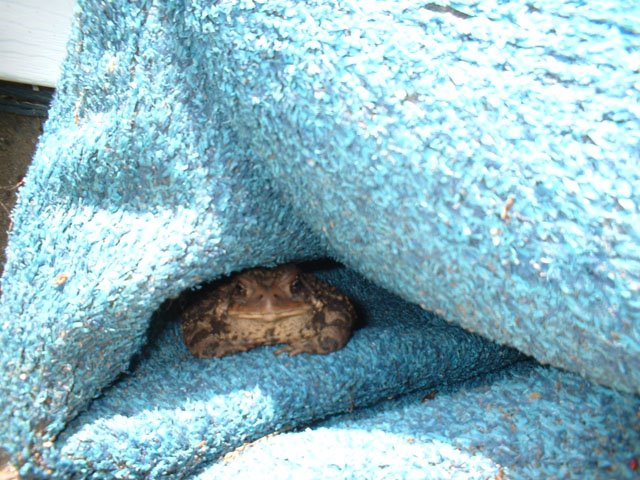
I take a rather laid back approach to visitors to my garden. Here's a picture of a cute little fellow that took up residence in a piece of rug my husband was supposed to put on the patio. He stayed with us until the fall giving my husband the perfect excuse not to put the rug down.
Mr. Toad

Other visitors are not so welcomed. We've had a problem with wild rabbits. They are kept out of the garden by using a motion activated sprayer called "the scarecrow" and in the case of one bed, I used a short height of chicken wire surrounding the bed. In the early spring when the threat of a heavy frost was quite real, I used a mixture of cayenne and powdered pepper. I don't like using this solution if at all possible. We've had a problem with other pests as well.

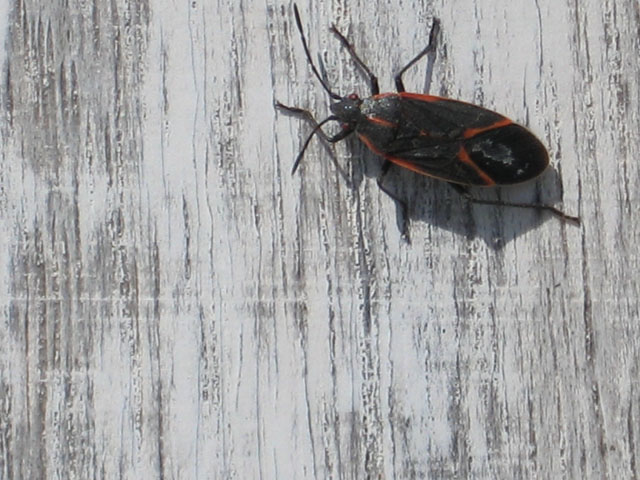
The box elder bug is more annoying than damaging.
Box Elder Bug
They hang around the garden having sex all day creating more of the little critters. If they get in your house or greenhouse they leave nasty little marks over everything. A solution of 3 - 4 drops of liquid dish soap mixed with water then sprayed on them gives an almost instant kill. It is about the only way to control them and even then it will not rid your garden of box elder bugs once infested. Controlling is the only way to deal with these little pests.

Caterpillars can be quite damaging in the garden especially the cabbage worm. Since I try to avoid pesticides where possible, I control caterpillars manually by removal. I didn't get a picture of the cabbage worms that destroyed my broccoli crop. The tomato hornworm can be destructive if left unchecked. While tomatoes are the primary target, this caterpillar will feed on peppers and potatoes. A natural enemy of the tomato hornworm is the braconid wasp that lays eggs on the caterpillar. The larva feed on the tomato hornworm until they are ready pupate. If you see white projections on the tomato hornworm it means it has been infected by the wasps so it is best to leave it in the garden. If no white projections are apparent, manual removal will prevent further damage.
Tomato Hornworm

The swallowtail caterpillar can descimate parsley or any member of the carrot family in a relatively short period of time, eliminating your entire crop. While the caterpillar is rather pretty it had to go! I've heard that removing these caterpillars to anise will save the parsley but since I didn't have anise growing last year, the caterpillars were simply removed. The funny thing is I never noticed any swallowtail butterflies around the garden and I do tend to take notice of garden visitors. This year I plan to take a different approach. Any swallowtail caterpillars will be removed from the main herb bed and place on parsley grown in pots just for them. That way I will be able enjoy the caterpillar, butterflies, and my parsley!
Swallowtail Caterpillar

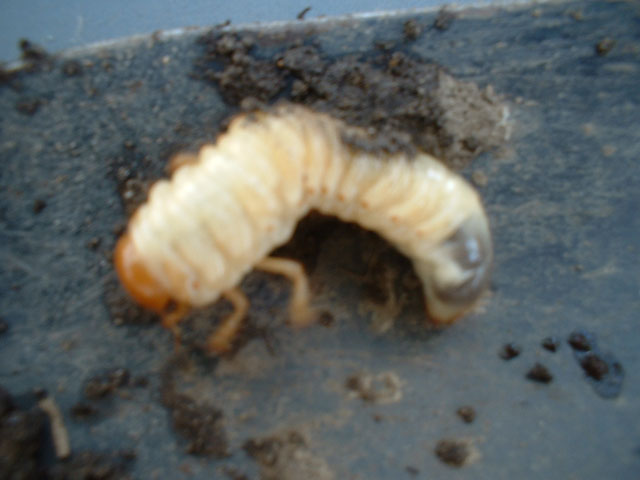
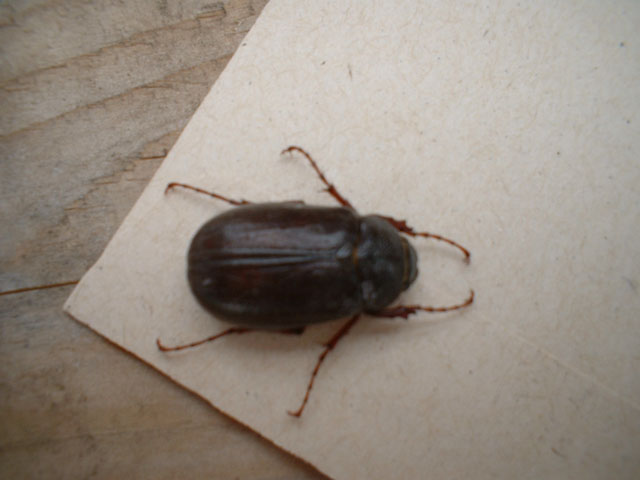
White grubs are really the bane of lawns. This grub will mature to become a June Beetle. Natural enemies of the grub are small mammals such as skunks and birds. Encouraging skunks in the garden might not be the most prudent thing to do so grub control is necessary. June Beetles are large chesnut brown beetles that look rather menacing. For the most part, I really don't get too hung up on them. Last year they showed up in the raised beds. Manual removal worked best without using any pesticides.

grub
June Beetle

I'll post my further adventures on garden pests in part 2.