Neighbours talking over the garden gate has long been a tradition. They share gardening tips, complain about the weather and pests yet are ever eager to discuss their gardens. That is what I had in mind when creating this blog. So stop by my garden gate to find out the latest happenings in my garden.
Happy Gardening!
Garden Gnome
"All my life through, the new sights of Nature made me rejoice like a child." ~ Madame Marie Curie"
Cacti
April 7, 2010
Before I get busy in this year's garden I thought I should update you on the
cactus seeds I planted in February of 2007 so they are now a little over 3 years old. We brought the seeds back from Las Vegas, Nevada in a cactus growing kit. I doubt we would have been able to get cacti plants on the plane and then there could have been problems getting them across the border so seeds seemed like a viable option. Cacti are very, very slow growers but they are also low demand and low maintenance plants. The largest is now about a half inch tall. It might be getting time to replant them.
Happy Gardening!
Garden Gnome
©2006-2010
As promised the desert dome in the Mitchell Park Conservatory (The Domes) in Milwaukee, Wisconsin conversation continues. Despite the temperature in the dome being close to the cold outdoor temperatures we spent a fair amount of time in the desert dome. There is just something about arid plants that appeal to me perhaps because they are just so exotic.
 Graham's Sage
Graham's Sage (Salvia microphylla [in US Salvia grahamii]) is a low growing perennial, evergreen shrub indiginous to southeastern Arizona and the mountains of eastern, western, and southern Mexico. It is a member of the dead-nettle Lamiaceae family sometimes referred to as blackcurrent sage. There are numerous hybrids and cultivars since the 1990s because the plant easily hybridizes. It is favourved for conservatory cultivation due to its long flowering season of up to 9 months outside and all year indoors. The flowers are arranged in whorls, with a wide range of color (magenta, red, pink, rose) depending on the cultivar. Unfortunately the Graham's Sage was not in bloom during our visit.
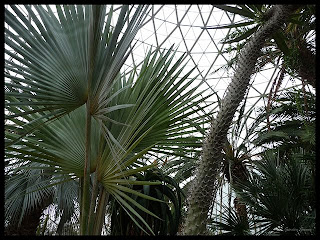 Palms
Palms
I fell in love with palm trees our first visit to Las Vegas that lined the streets and graced most landscaping. That love was reinforced through a few trips to Florida but my gosh where I really started to appreciate them was in Key West. The palms waved in the wind making a rustling sound while providing cooling shade in the heat of the sun. In the evening hours the shadows created by the palms were amazing then at night listening to the rustling in the deep darkness it was easy to believe the local ghost stories. Perhaps the local ghosts were actually visiting us!
Happy Gardening!
Garden Gnome
©2006-2010

Yesterday I posted on a bit on the desert dome at the Mitchell Park Conservatory (The Domes) in Milwaukee, Wisconsin. I took a fair number of pictures so will be sharing some of those with you over the next couple of days. Cacti can be grown successfully indoors in northern climates in a sunny window. It is amazing to see the variety of cacti available, some more suitable to growing indoors for the gardener than others.
 Cleistocactus
A nice feature of conservatories is many of the plants are labeled with their common and scientific names. If this is a plant you are interested in trying your hand at growing then take a picture along with recording the tag information. This will help ensure you get exactly the plant you are looking for.
Cleisrocactus (Cleistocatus hyalacanthus) [note a typo on the card] is a columnar cactus that is hardy to USDA Zones 10 and 11. This tall, fuzzy cactus grows to 4 - feet in height with small pink or pale red diurnal flowers about 1.6 - inches long.
 Welwitschia
Welwitschia (front bottom) is a low sprawling, sideways growing plant that grows from a short, thick, woody trunk. Two leaves continuously grow from their base for the entire lifespan (1,000 years or more) of the plant. These leaves split to form several strap-shaped sections disguising their origin. Welwitchia has a long, thick taproot.
Variegated Elephants Bush (Portulacaria afra variegata), just behind the Welwitschia is a small branching succulent shrub. It resembles a small variegated jade plant. This plant can make a fabulous indoor or outdoor container plant. If growing outdoor it is hardy to USDA Hardiness Zone 10. Indoors treat as would other succulents such as jade. Be careful to not overwater. Variegated Elephants Bush has tiny pink blooms but these are seldom seen under cultivation.
Happy Gardening!
Garden Gnome
©2006-2010
Living in Ontario, Canada I don't have a lot of experience with cacti other than the few I grow on my windowsill. My little cacti seedlings are coming along nicely and while they are about double in size they sure take a long time to grow! I can fully appreciate how long it takes for a cactus to get to any appreciable size. Mine are now 3 years old and aren't even big enough to transplant. I'll have to remember to post an update :)
Most think of the desert as a hot, dry area and it it but it is surprising how very cold the desert can get! We've been in the Mojave Desert several times. While the temperatures can be stifling hot as high as 134ºF in Death Valley during the day the low can be as low as 8ºF at night. The Desert Dome of the Mitchell Park Conservatory (The Domes) was really on the cold side not much warmer if any than outdoors when we went through. Coats were a must!
 Aloe Vera
I took a lot of pictures in the desert dome. Despite the cold it was quite enjoyable. Understated yet rustic accents like a cattle sculls were scattered randomly throughout the dome. Once again the dome was set up with plants bordering the perimeter of the dome with a well planted central region containing a small pond and a meandering path with benches to sit and enjoy.
I immediately recognized the aloe vera plant in the lower left corner. Aloe vera is a must have plant in any home. It is low maintenance with healing benefits especially for kitchen cuts and burns. I love the natural looking landscape showing this wonderful plant in its natural environment.
 Golden Barrel Cactus
The Golden Barrel Cactus (Echinocactus grusonii) is a Mexican native that is a protected species even though it is a popular cultivated species especially for houseplants but also in landscaping in suitable areas. This cactus lives to to be several hundred years old. The spines provide shade yet help catch rainfall directing it to the base of the plant. The accordion like folds expand and contract depending on the amount of rainfall the plant absorbs. One myth is the barrel cactus is a reservoir for fresh water but this is wrong even though moisture can be squeezed from the pulp.
Happy Gardening!
Garden Gnome
©2006-2010


 Graham's Sage
 Palms
Palms Cleistocactus
 Welwitschia
 Aloe Vera
 Golden Barrel Cactus