Neighbours talking over the garden gate has long been a tradition. They share gardening tips, complain about the weather and pests yet are ever eager to discuss their gardens. That is what I had in mind when creating this blog. So stop by my garden gate to find out the latest happenings in my garden.

Happy Gardening!

Garden Gnome
"All my life through, the new sights of Nature made me rejoice like a child." ~ Madame Marie Curie"
Showing posts with label plant propagation. Show all posts

Sunday, March 04, 2012

Hybrids vs Heirloom Plants

When it comes to gardening there are two types of plants - hybrids and heirloom.  In order to understand the difference, you need to know a bit of basic genetics.  An heirloom plant is one that has not been modified other than by nature.  It breeds true  meaning if you collect seeds from the plant, the resulting plants from the seeds will be the same as the parent plant (P).  An hybrid is the crossing of two parent plants with different characteristics to result in a unique plant.  Now, let say we cross a plant with white (rr) flowers and a plant with red (RR) flowers.  I'm using r as the recessive allele and R as the dominant allele.  The rr and RR are the alleles for the flower colour so in this case the only way to get white flowers is to have two alleles that are recessive while the only way to get red is to have two dominant alleles.  Two of the same alleles is called homozygous.  A hybrid occurs when you cross two homozygous plants to form a heterozygous plant for that particular trait.  So in this case the cross is RR x rr.  The resulting pink flower plant (F1) is the hybrid that in terms of alleles is Rr and it does not have the same flower colour as the parents (white, red).  What happens if we take that hybrid and cross it with the same hybrid for the next generation (F2)?  Consider a cross between a pink flowered plant (Rr) and a pink flowered plant (Rr).  What we end up with is a 1:2:1 ratio of 1 RR (red):2 Rr (pink):1 rr (white).  In other words seeds collected from the hybrid do not breed true so you may get the one you want (pink) but there is also a chance of getting one you don't want (white or red).

To complicate matters further, plant reproduction can be sexual (seeds) or asexual (cuttings).  Even if you start with a hybrid, if you propagate via asexual methods, the resulting plant will be the same as the parental plant.  However, as we see above if a hybrid is propagated sexually the resulting plant may or may not be the same as the parental plant.  As a home gardener, what this means is seed collection should be done from heirloom plants not hybrids.   These are the seeds you want to keep to grow the same variety the following year.  Some hybrid plants are propagation protected meaning you can collect seeds but you cannot legally propagate via cuttings.  If you want to take cuttings from tomatoes to grow indoors, you should not take them from a propagation protected hybrid tomato plant.  There is nothing wrong with collecting seeds from hybrids but be aware some seed developers have introduced a gene into their hybrids that essential render the plant sterile meaning any seed produced will not germinate.  It would be a shame to collect seeds from hybrids anticipating the same variety the following year only to find you end up with something else (not always a bad thing) or worse yet the seeds don't germinate.  In addition to this, some seed developers have also introduced a marker gene into the plant's genome so they can identify plants illegally propagated.  This is not a huge concern for home gardeners unless you are selling or trading plants that are propagation protected.

I use a combination of hybrids and heirloom plants in my gardens.  I collect seeds from both but tend to focus on seed collection of heirlooms first to replenish my gardens for the following year.  I am careful to label as to whether the seeds were from an heirloom plant or hybrid plant but the reality is plant tags get lost over the growing season so sometimes a clipping gets through that shouldn't.  I'm not selling plants though.  When it comes to hybrids, I try to use hybrids that are not propagation protected especially for tomatoes that I like to grow indoors during the winter months.  Heirloom seeds are the ones you want to collect and protect!

Happy Gardening!

Garden Gnome
©2006-2012


Sunday, February 26, 2012

Pothos (Epipremnum)

Pothos (Epipremnum) is a beautiful, low maintenance house plant that with white or yellow variegated leaves, or the leaves can be solid green.  It is commonly called devil's ivy or variegated philodendron.   My pothos is about 10 years old.  It grew nicely until we moved to our last house where no plants wanted to grow indoors.  I struggled for 4 years to keep him alive and I do mean struggle.  When we moved here, the pothos started to perk up much to my delight.

pothos in self-watering pot
I repotted the pothos in an EZZY-GRO  self-watering planter then moved him into the entrance way.  This is a bright location with lots of natural light thanks to side lights on the door, an arched window above the door and a beautiful southern exposure.  I added a bit of liquid fertilizer into the reservoir just for good measure.  I took this picture two days after repotting and could not believe the difference.

The depth of the green has been very much enhanced.  Although there are signs that more recovery is needed, it is obvious that my pothos loves his new planter and location.  Each day there are more signs of improvement so I am quite happy!

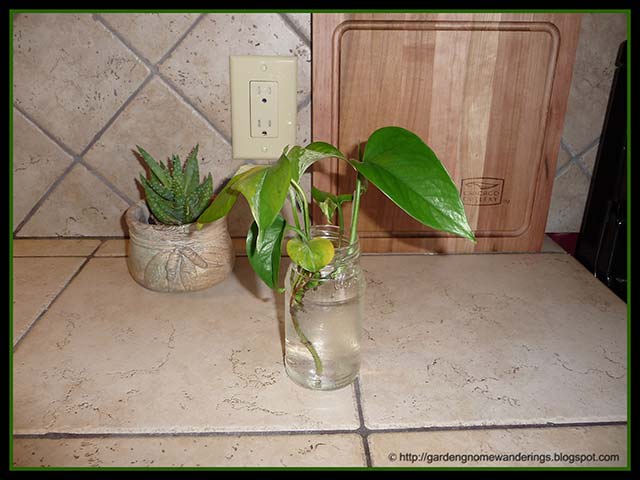
pothos clipping
When I was repotting the pothos a piece accidently snapped off.  I immediately popped the piece into a jar of water for rooting.  Pothos propagates nicely using the water method or you can stick the cutting into a pot of vermiculite.  If you use the vermiculite method, use a bit of StimRoot® #1 for softwood cuttings.  This is a hormone that stimulates root production.  Either way, the cutting will develop roots.  Once the roots are about 2 - inches  long, the cutting can be potted in soil.  

When my pothos is back to full health, I will start making a few more clippings.  This will give me a few more plants while encouraging new growth on the parent pothos.  In the meantime it is a bit of TLC for the pothos.

Happy Gardening!

Garden Gnome
©2006-2012


Monday, September 26, 2011

Coleus

Eons ago I first became interested in gardening as a child but a few years later my environmental science teacher hired another student and myself through the school.  Our job on the surface was easy, to help out with the greenhouse.  The real purpose of the job was to teach us how the greenhouse was maintained including all the operational functions.  I absolutely loved it!  I would spend every single minute I could outside of class time in the greenhouse.  Years later through during my academic career as an adult I spent many hours of free time equipped with my lunch and camera then later with laptop enjoying one of our universities small greenhouses.  I still enjoy greenhouses especially during the winter months in beautiful Ontario, Canada.

coleus
One of the very first plants I learned to propagate was coleus.  Coleus is a beautiful, lower growing ground cover outdoors or an lovely potted houseplant although it is more difficult to get it to bloom indoors.  It will thrive in lower light conditions while adding a splash of colour to garden beds.  I particularly like using coleus in pots outdoors as accent plantings that can be brought indoors for the winter.

Coleus benefits from pinching that results in thicker, bushier plants.  It can be propagated by dipping a cut stem in rooting hormone then putting the prepared stem in moistened vermiculite or the stems will root simply by placing them in water.  If using the water method, fill a glass jar with water to about a half-inch from the top.  Cover with plastic wrap and secure.  Poke two or three holes in the plastic wrap.  Let the prepared jar sit until the water is at room temperature.  Cut the same number of stems as holes from a healthy coleus plant.  For best results the stems should be about 4 to 5 - inches long.  Remove any bottom leave.  Poke each stem down into the holes until they are below the water level by about an inch.  Set in a location out of direct sun.  It will take a few days for roots to appear.  When the root ball is sufficient, pot each rooted stem in individually prepared pots.   If planting outdoors allow the new coleus plant to become established in the potting soil first then remove from the pot and plant in prepared outdoor locations (ground or containers).

Happy Gardening!

Garden Gnome
©2006-2011


Thursday, July 15, 2010

A Few Thoughts on 'Propagation Prohibited'

Yesterday I mentioned that the geraniums I had bought had propagation prohibited on the tag.  Essentially the plant developer holds the rights to that plant so you are not supposed to propagate the plant by asexually means such as cuttings or divisions.  You can however propagate the plant through pollination meaning you can collect seeds it produces.  On the surface the Plant Holder's Rights offers protection to the plant developer for their intellectual property.  However, it is up to the plant developer to enforce their rights.  They must go through the court system for damages if someone infringes on the Plant Holder's Rights.  Herein lies some of the problems with the Plant Holder's Rights.

  • The only policing of Plant Holder's Rights is the person (company) who owns the rights to their protected plant.  The onus is on them to provide evidence that you are asexually propagating their protected plant and selling or otherwise distributing it.  Unless the plant has been rendered sterile through the hybridization it would be difficult to determine visually if propagation had been asexual or sexual.  Genetically suspected plants could be tested but the reality is this is costly and not really feasible unless a lot of money is at stake.
  • They cannot legally enter onto your property to see if you are propagating their protected plant.  In extreme cases where there is sufficient evidence that you are selling their protected plant in amounts that would indicate that you were propagating large numbers of them, they might be able to get a warrant. 
  • Plant tags get lost all the time.  As a home gardener it is easy to remember the names of plants but whether one is protected or not is a detail easily forgotten especially over the years.  In a mature garden tags more than likely are non-existent.  Adding to this problem is people often move inheriting whatever plants the previous owner planted in the gardens.  Without plant tags the new homeowners have no idea whether a plant in the garden at the house the just moved into is a protected plant or not so may easily propagate the plant via cutting or division. 
How does the Plant Holder's Rights affect you as a home gardener in Canada?  Essentially as long as you are not propagating a protected plant for the purposes of selling it you are fine.  Taking a cutting or dividing the plant for your own personal use if fine especially as some plants must be divided otherwise they become too crowded and you end up losing the entire plant.  I would not recommend trading any plant from your cuttings or divisions and certainly do not sell any.  Trading does seem to be a bit of a grey area though as does giving away plants from cuttings or divisions.  Again it goes back to the problem that you may not even know a plant in your garden is protected.  You can certainly collect the seeds but realize that hybrids do not breed true.  This in itself can be an interesting experiment just to see what you do end up with and you might like the resulting plants even though they don't resemble the parental plant.  You have a better chance of getting a parental type if you cross pollinate two of the hybrid plants.  Some plant developers recognize this so have developed the plant to be sterile. If you want to avoid the whole issue of Plant Holder's Rights then don't buy any hybrid plant marked with PP, propagation prohibited, asexual propagation prohibited or PPAF (propagation prohibited application filed).  Technically PPAF has no bearing on the home gardener since the plant is not and possibly might not be granted protection.  Older heirloom varieties are another option for your gardens. 

Happy Gardening!

Garden Gnome
©2006-2010


Wednesday, July 14, 2010

Pinnacle Salmon '07 Geranium

Pinnacle Salmon geranium
Pinnacle® Salmon '07 Geranium
July 12, 2010


Geraniums have never been my favourite garden plant.  The reason being my mother would line every windowsill in the house with geranium cuttings in the fall so she would have geraniums for the following year.  I found the scent overpowering.  The past few years I have come to appreciate the simple beauty of geraniums.  They are available in a wide range of colours and some even have double blooms.  I find they add a wonderful splash of colour.  Geraniums are also relatively problem free making them ideal for new home gardeners.  I'm a bit partial to the salmon geraniums.  I bought 10 of these geraniums from our neighbour's kids who were selling them as a school fundraiser.  As a result they were a bit more expensive at $3 each for a 4" potted geranium but it was going to a good cause.

What is interesting about this particular variety of geranium is on the tag it says propagation prohibited.  This is becoming increasingly more common for some hybrid flowers.  It means the plant developer owns the patent on that cultivar.  It sometimes appears as PP on the tag.  However, it is basically useless for home gardeners propagating plants for their own use!  First few read the tag anyway especially for plants like geraniums and second the tag usually ends up being lost because the plants are repotted.  Unlike many, I tend to keep the tags with the plants if at all possible but that is simply for easy identification of plant varieties later.  Any home gardener is going to propagate the plants they like.  That is a given.  In this case the plant developer is concerned about asexual propagation (cuttings, division) not pollination.  The reason is asexual propagation results in exact copies of the plant that they hold the rights to.  The idea that the plant developer can prevent a home gardener from using asexual propagation methods on their protected plant is nonsense but they can prevent you from selling any plants propagated asexually from the original plant.  It's the same principle as the music copyright issue.  They can't stop you from making a copy of a song for personal use but they can go after copyright infringement if you sell the copy.  Technically, the propagation you can do on plants that are marked propagation prohibited are by pollination (sexual plant reproduction).  So you should not collect seeds or take cuttings however some plants will propagate through dropped leaves or seed.  Legally you do not have to destroy the plants that result from this but you cannot sell those plants.  The plant can be divided to suit your needs but you cannot sell the divisions.  

In Canada a plant developer can apply for Plant Holder's Rights.   Once granted the rights are for 18 years providing a renewal fee is paid annually.  There are two exemptions to the Plant Holder's Rights


Research Exemption: Protected varieties may be used for breeding and developing new plant varieties without the permission of the holder of the rights.
Farmers' Privilege: Farmers may save and plant their own seed of protected varieties on their own land without infringing on the holder's rights.

A plant developer's rights may be revoked for failure to pay the annual fee as well as failure to maintain propagation or proving the variety is being maintained.  The rights can also be revoked it is found the plant developer was selling the variety before being granted the rights.  It is quite possible that even though the tag says propagation prohibited the plant is no longer protected under the Plant Holder's Rights.  From a home gardening perspective, taking cuttings from a propagation prohibited plant to create new plants should be for personal use only.  However, there is nothing to restrict you from collecting seeds from the plant or using that plant to do a cross with another variety of the same plant to create a new but different plant from the parental plant.

Happy Gardening!

Garden Gnome
©2006-2010


Wednesday, June 30, 2010

Volunteer Tomato Plants

volunteer tomatoes
Volunteer Tomato Plants
June 25, 2010

We've had a fair amount of warm days followed by rain in the afternoon and evenings mixed with rainy days.  The combination has seen weeds sprout up on the garden paths so they are getting to the point of needed to be cleared again.  A couple of days ago I noticed two volunteer tomato plants on one of the paths and there is another one in the first raised bed.  Volunteer tomato plants are fairly common, sprouting up from seeds that survived in the soil over the winter.  I've even had volunteer tomato plants come up around the compost bin and the year the squirrels kept snitching tomatoes I found tomato plants coming up along the fence. 

I tend to keep any volunteer tomato just to see what kind of tomatoes I get.  If the volunteers were from hybrids the results can be interesting.  If they are from heirloom tomato seeds then I end up with a few more heirloom plants (eg. Brandywine).  Depending on where the volunteer tomato plants are I will transplant them into 5 gal containers or to a more convenient location.  I don't plant them in with the main bed tomatoes so I can try identifying them if and when they produce fruit.

Happy Gardening!

Garden Gnome
©2006-2010


Saturday, September 19, 2009

Tomatoes

This is a wonderful time of year in the garden! The garden is blessing with it's abundance daily. I am dealing with a couple of problems and the ADFF (average day first frost) is quickly approaching. The days are getting shorter and cooler. The evenings have been fairly cool as well. After such a cool, wet summer it is hard to know whether we will have a nice autumn although that is the prediction. I'm not taking any chances in case we get frost earlier than expected.

vine ripe tomatoesVine Ripe Tomatoes

Pictured is yesterday's tomato harvest. There are Sweet Millions (cherry), beefsteak (upper right), Lemon Boy (bottom right) and Heinz 1429 (bottom left). By far my best producers are the Sweet Millions, beefsteak and Heinz 1429. The Sweet 100's have produced very little. The Lemon Boy has once again proved itself to be somewhat problematic, low performers.

Recently the rain has been less resulting in less tomato splitting. By far the cherry tomatoes have been most affected by splitting. Tomato splitting occurs when the tomato roots take up too much water causing the fruit to plump quicker splitting the skin. The next problem is some tomatoes simply falling from the vines. This is primarily affecting the Heinz 1429 tomatoes although it has happened with the cherry tomatoes as well.

late blightLate Blight

Throughout the entire growing season there have been horror stories of late blight. Late blight is a fungal disease that rapidly spreads through tomato plants. This year it has been particularly bad. True to previous experience Lemon Boy was the first to be hit with blight. Late blight is controlled by removing damaged foliage and not composting it. Washing your hands well after working with an affected plant will also help control the spread.

I noticed the first signs of late blight a couple of days ago. At this late stage in the outdoor there is little point getting too stressed about it. I'm removing as much damaged foliage as possible while trying not to knock of immature fruit so there is a bit of a trade off. I also noticed a couple of tomatoes with blight damage so I removed those as well.

tomato clippingsTomato Clippings

At the same time I am taking a lot of clippings of the healthy growth for growing indoors. Pictured is the first grouping of clippings to come indoors. As you can see the foliage is quite healthy. It is important to ensure any foliage used as a clipping is healthy to prevent any disease from spreading through the indoor garden. I cut a clipping and put it into a water filled container then wash my hands and repeat for 4 clippings per container. Then I set the container on the patio well away from the main garden and other clippings for a week. As long as there are no signs of disease, I check for any insects and manually remove them then bring the clippings indoors. The clippings are checked daily for any signs of insects. Indoors I use manual removal combined with a homemade soap spray if necessary. Once roots form the clippings are either planted in soil or left as individual plants in water. I use an organic fertilizer for the plants. As the plants grow the process for rooting clippings is continuously repeated throughout the winter.

Happy Gardening!

Garden Gnome
©2006-2009


Thursday, June 18, 2009

Dealing with the Unexpected in Gardening

Gardening is one of those activities that come with a lot of risk. You plant your seeds and seedlings then with a bit of tending you hope for the best. Many a gardener has woke to find their carefully planted garden destroyed by hungry rabbits or deer. Gardens are often raided by marauding four legged and two legged thieves. As if that is bad enough the gardener is faced with adverse weather conditions that can easily wipe out an entire productive garden in the matter of seconds through hail, pelting rain or high winds. Sadly for many a vegetable garden really does make the difference as to whether they can afford to eat or not. They depend on their gardens not only for fresh vegetables but also to put up food for the winter. Barring a catastrophic event (eg. tornado, flooding and etc.) there are a few things you can do to buffer these types of problems.

  1. shelter your garden - Tuck your vegetable garden up into an area where it is sheltered from the wind by buildings, fences or vegetation windbreaks. If the only spot you can plant a traditional row garden is in the open create a windbreak with taller plants or temporary windbreak fencing. Raised beds and container gardening need a bit more protection.
  2. barriers - A barrier is a great deterrent for garden raiders. The type you choose will be very dependent on the pests you want to keep out. A low close knit fence protected also along the bottom with chicken wiring is effective for keeping rabbits, mice and rats out of your garden. If raccoons are raiding your garden run a line of low voltage electric fence around the perimeter of your garden about 9" from your low fence. Deer and humans present a special case. Most recommend at least a 6' high fence although a determined human or hungry deer can likely still get in.
  3. motion deterrents - One of the most effective pest deterrent I've used is a motion activated sprayer that makes a lot of noise while spraying a jet of water in the direction of the motion. For the best protection move the sprayer to different locations in your garden so pests do not become acclimatized.
  4. plant disease and/or drought resistant varieties - This will minimize any losses due to certain diseases and dry conditions.
  5. plant extra - This sounds like a given but always plant extras to guard against loss from disease or insect infestation. One easy way to get extras through the season is to take clipping and root them. Pinch tomato suckers and root them in water. Many herbs will root in water as well. Start extra plants from seeds. Keep a good variety of your extras indoors, in a screened in sun porch or balcony as a bit of insurance. If disaster strikes harden off your indoor plants then replant your garden. You will lose a little as far as yield but not a lot. Essentially what you are doing is creating a small container garden as a back-up.
  6. replace the plants - If your garden has been stripped an alternative is to replant using slight older plants from the nurseries. This approach will work well for many plants and is one trick to establish a garden if you get a late start planting. In late spring and early summer practically every store that sells plants greatly reduces the prices. This is a good time to pick up replace plants at bargain prices.

Happy Gardening!

Garden Gnome
©2006-2009


Friday, September 12, 2008

Vinca major (Bigleaf Periwinkle)

One of our smaller garden beds has a pretty green and white creeping vine that has little purplish blue flowers in the early spring to mid-summer. It was quite apparent that the vine was of the spreading nature. It had filled the garden bed and was heading down the divider between our driveway and our neighbours. Our driveway is paved but his is gravel so the vine had no problem spreading and rooting. Still it was pretty so I set out to identify whether the vine was friend or foe. At the same time I started trimming it back and asked the neighbour if he wanted it removed from his side. This is always a nice thing to do if something you have in your garden encroaches onto the neighbour's yard to ensure good neighbourly relationships.


Vinca major varigata Louden
(Big Leaf Periwinkle)

Vinca major L. is a very fast growing perennial, ornamental ground cover that has small, five petal, purplish blue flowers often referred to as Bigleaf Periwinkle. The leaves are green with creamy white edging. It is not a climber but can be draped over edges and fences to soften the look. It looks very pretty trailing over the hard edges of flower beds and retaining walls. Vinca major grows nicely in full sun to shade. This vine is low growing at 8 to 12 inches high but it is quite invasive with trailers spreading up several feet. This vine can easily take over an entire garden forming a dense mat and overwhelming other plants. However, its dense growing pattern also keeps any patches of Vinca major weed free. Vinca major is a wonderful substitute for grass because in those areas where you don't mind its spreading nature. It is rather maintenance, pest and disease free. Neither deer or rabbits will eat Vinca major. Aphids may occasionally appear on the leaves but can easily be removed using a strong spray of water. This vine is perfect for sloping areas to prevent soil erosion. In temperate areas the vine is an evergreen. Cuttings can be taken to grow in containers and hanging baskets. Vinca major is quite drought tolerant and over watering will kill the vine so be careful to not over water. It is best to water the soil rather than the plant to prevent an fungal spores present in the garden from settling on the leaves. Propagation is by cutting. If you want to remove Vinca major the best way is to manually pull it out. Do not mow it because the vine has the ability to re-sprout.

Now that I have identified this creeping vine the next decision is whether to move it to another location. It would be better to move this invasive vine to one of the confined garden beds where it can only spread as far as the surrounding hard surface barrier like the space between the house and side walk. I will also be starting a few pots of Vinca major, over winter indoors then use them in planters next spring.

Happy Gardening!

Garden Gnome
©2006-2008


Friday, June 15, 2007

Trumpet Vine


Trumpet Vine
(Campsis radicans)

Years ago when we bought our second house there was a vine growing up the south side of the house. This was an old, turn of the century, wood sided, two storey house in need of tender loving care. We were young and naive so tackled the job that ended up being an almost 12 year project. We did everything from designing a huge kitchen, re-roofing, siding, new wiring, new plumping, refinishing wood, installing a pool with large two level deck and privacy fencing. Finally we tired of our money pit and sold it for a non-descript subdivision house with no character but minimal work. We are now moving into house number five and a bit wiser but back to the vine.

I thought the vine was beautiful. It was a bright green and shaded a good portion of the southside wall in the summer. It never flowered in that location as my husband ripped it out because it was damaging the wood siding. We found remnants of the vine under the second story siding coming through the wall when we did the wiring! I salvaged a few pieces, set them in water to root then planted them along what was then a chain link fence. By the time we put in the privacy fencing the vine had grown considerably so I decided to leave it to soften the look of the fence despite my husband's protests. I was rewarded with beautiful deep orange trumpet shaped flowers. A few years later when we sold, the vine had covered a good portion of the fence and was pushing some of the fence boards loose. My husband declared it a weed worthy only of Round-up but it was too late, I had already fallen in love with this beautiful vine.

After we moved, I was at the nursery looking for plants when I discovered the same vine except it had yellow flowers. It was a trumpet vine (Campsis radicans) so I bought it much to my husband's dismay. I had strict orders not to plant it anywhere near the house! I brought a piece with me when we moved here and planted it by the old garage now being used as a garden shed. The vine is growing nicely but hasn't flowered yet. I'm taking a few cuttings with me to the new house.

The trumpet vine is a low maintenance, fast growing and spreading vine that is ideal for privacy screening. It is pest free and fairly drought tolerant. In fact, this is one vine that lives on neglect. It transplants easily and new vines can be grown from cuttings. The beautiful trumpet shaped flowers attract hummingbirds, wasps and bees all of which are beneficial pollinators in the garden. Unfortunately, the trumpet vine can be invasive and should not be planted against houses or other buildings. It is best if contained somewhat to prevent the invasiveness. So becareful where you plant this vine. The trumpet vine can cause rashes for some people so gloves should be worn when handling the vine. Propagation can be through cuttings or air layering.

Happy Gardening!

Garden Gnome
©2007