Neighbours talking over the garden gate has long been a tradition. They share gardening tips, complain about the weather and pests yet are ever eager to discuss their gardens. That is what I had in mind when creating this blog. So stop by my garden gate to find out the latest happenings in my garden.

Happy Gardening!

Garden Gnome
"All my life through, the new sights of Nature made me rejoice like a child." ~ Madame Marie Curie"

Tuesday, June 27, 2006

Garden Planning

We had five raised beds and now have eight all planted in the square foot gardening method using companion planting. The beds are planted based on the ADLF. This means the cool weather crops are planted a month before the ADLF, some are planted on the ADLF and the frost sensitive plants are planted two weeks after the ADLF. For that reason garden planning is a must. This planning starts with the previous growing season. As the fruits, herbs and vegetables grow I make careful notes in my journal.

I think keeping a detailed journal is a very important part of gardening. It will help you troubleshoot and plan for the following growing season. It will help you determine which varieties do best in your hardiness zone. I record the weather conditions and how the plants are growing. Any problems such as pests or possible disease are recorded with as much detail as possible. More importantly I take pictures and include them in my journal. Quite often I will sit down in the evening, read over my notes and realize that there is a problem that needs attention. Without my notes and pictures it might easily have been overlooked. I can't stress the importance of a gardening journal enough.

Once the beds are prepared for the winter I review my garden journal and pictures then start planning for the new garden season. I make a list of what grew well then create a layout for each bed. Of the five original beds, one is dedicated to strawberries so needs no plan. The excitement grows when the first seed catalogue arrives. I like both OSC and Stokes for the ease of ordering online. Once the seeds have been ordered I start a more formal plan. I used to do this by drawing out each layout by hand but now I'm using Garden Manager Pro software. This software has the vegetable information and garden layout adapted from Square Foot Gardening by Mel Bartholmew and has greatly simplified the layout planning.

Using the recommended square foot gardening recommended densities for each plant along with companion planting recommendations, I came up with the layouts for the beds then printed them off. As you can see the working copy becomes rather cluttered. I use it for making quick changes and notes of when to plant. Like any plan some flexibility is needed. Each square has a number in brackets after the plant name. This indicates the planting density. For example in bed #2 that is home to the herbs, I decided to plant lettuce in a couple of squares. The number after the lettuce appears as (4) meaning four lettuce plants to that square. I also use colour coding for a quick visual for when to plant according to the ADLF. This is really just a simple scribble with a pencil crayon. I even use Xs or checkmarks to planting times or if the square was planted. While the working copy appears to be cluttered it holds a lot of valuable information.
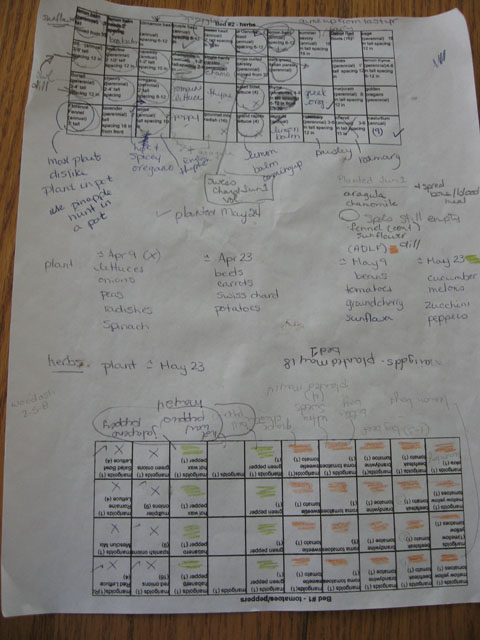
Working Copy

Sometimes a quick change is necessary if a volunteer plant is discovered. In bed #5 two volunteer sunflowers came up. Since that bed wasn't fully planned, I left them where they were and just incoporated them into the final bed layout. A volunteer pea plant surprised me in bed#3. Since it was in the bed where the beans and peas were going to be planted I simply left it there and noted the change on the working copy sheet. There are times when I realize I made a mistake in the planning process as in the fennel planned for bed #2. Fennel doesn't get along well with other plants so I decided to plant it in a container. I have also realized that lemon balm is a member of the mint family so is very invasive. It is everywhere so will have to be moved out of the herb bed. Mistakes are a good thing if you learn from them.

The herb bed is the easiest to plan as the perennials are already there so planning is only needed for the annual herbs. Again quick changes were necessary. I had a problem with the germination of some herbs in the greenhouse so found myself with nothing to plant in those spaces. Unfortunately the local nuseries didn't have potted herbs that I wanted. That left me with spaces to fill. When using the square foot gardening method there is nothing wrong with leaving a space empty or filling it with a non-edible companion plant.
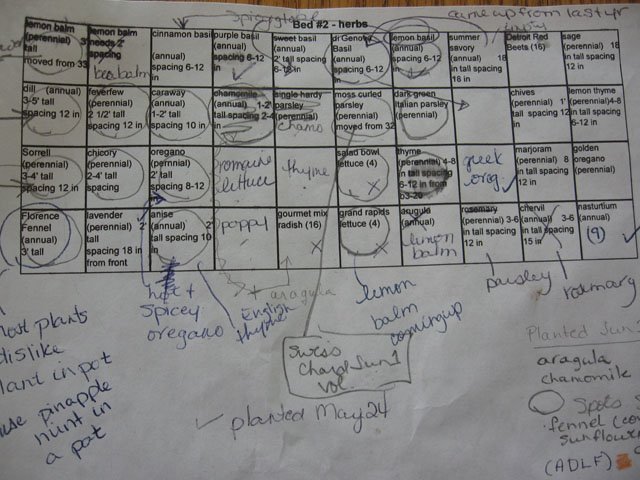

Herb Bed Plan

When using the square foot gardening method, the plan is only a guide. As the cold weather crops like lettuces, spinach, radishes and peas finish the squares are replanted with another crop keeping companion planting recommendations in mind. Some squares like the pole beans, tomatoes, perennial herbs, peppers and onions will remain constant without replanting throughout the entire growing season. These are the plants I use to plan the layouts. They are planned first and everything else worked around them. Even with very careful planning always expect surprises and be willing to be flexible. My peas thew me a curve ball this year. Other years they have been punny and almost non-productive. This year I tried a couple of different varieties. They are over five feet tall and we had to make emergency supports for them. I'm not complaining as they are loaded with pods but this was totally unexpected. You can bet I'll be growing these varieties next year!

Planning your garden can be a very rewarding part of gardening. A well thought out and planned garden is more likely to be successful. Start planning your next season's garden with this season.

Happy Gardening

Garden Gnome


Tuesday, June 20, 2006

Constructing a Square Foot Garden Bed

Raised beds can be used for veggetables or flowers and can be planted using the square foot method. The square foot method of gardening is ideal for smaller spaces. Constructing a square foot garden bed is very easy. Since we just installed new beds, I thought I would share how I make my beds.

In the true fashion of square foot gardening, beds are constucted 4' x 4' but you can make them any length you want just don't go beyond 4' wide. That will give you 2' comfortable reach from both sides and the ends if you make your beds longer than 4'. The reason for this is you need to be able to reach all around the bed without walking on it. Do not use pressure treated lumber! I prefer 2" x 8" or 2" x 10" untreated spruce lumber but you could use cement blocks if you know you won't be moving the bed. While no bottom cover is necessary you can use garden cloth if you want. I don't use any bottom cover. The beds are set on the grass then filled. You can make your beds deeper than eight or ten inches as well. If you have mobility issues a 36" high raised bed will make it easier to garden. The bed is constructed in the same manner but with a bottom then raised on four posts to the desired height.

Beds should be layed out in such a design to allow a 3' pathway especially if you use a garden cart or wheelbarrow. You can go narrower but 3' makes the pathways wheelchair accessible. Choose your pathway material wisely based on durability, accessibility and ease of revamping. All have pros and cons. I prefer gravel but you can use other material for the pathways. I

My beds are constructed using a simple butt joint with no reinforcement. Three long galvanized nails at each joint does the trick. When I first constructed the larger beds I thought reinforcement would be needed but after almost 4 years they still look good. The spuce weathers nicely to grey that just seems to mellow the garden. You can add reinforcement at the joints if you want. This can either be 2" x 2" or L-brackets. My beds are not anchored to the ground either because at some point I may want to change my garden layout. While that is highly unlikely I don't see the need to anchor them into the ground.

Soil is the next concern and may need to be adjusted based on your zone or the plants you are growing. Adjust as necessary based on your climate and the plants you are growing. I started out using 1/3 compost, 1/3 peat moss and 1/3 top soil. I've since modified the original beds with soil ammendments such as manure, vermiculite and leaves. I recommend using an organic fertilizer after the first year simply because like containers nutrients leach out of the beds.

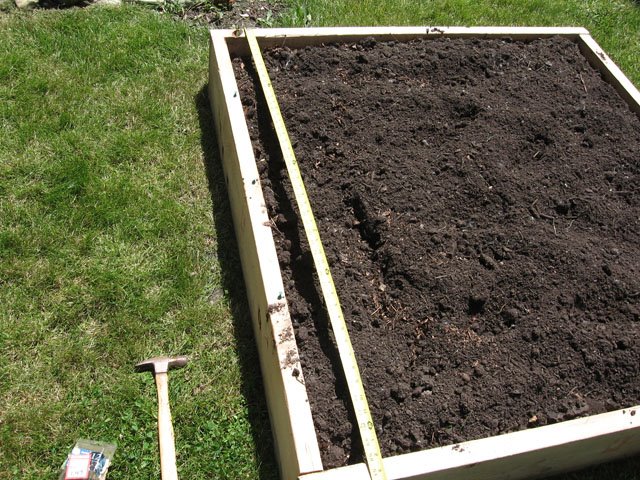
Bed constructed and filled

The actual contruction was simple so I've started the pictures at where the bed has been filled and was ready for the grid system. The grid is important as that is what forms the basis of the square foot gardening method.

Measuring Up

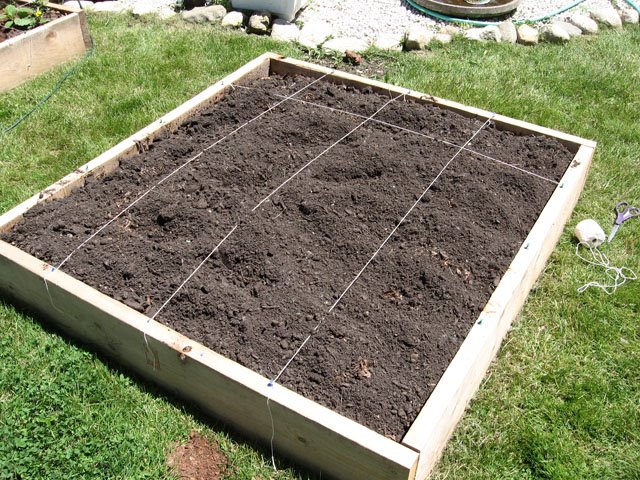
Once the bed is filled it is time to measure up the bed. Use a tape measure and run from end to end. Mark each side at 1' intervals around the perimeter of the bed. I now skip the step of marking and use push pins as I go.


Cotton Yarn

By far the most convenient, cheap way to secure the grid is push pins especially if you use cotton yarn as I do. The cotton yarn is biodegradable and birds will collect any left-overs for building their nests so it is a win-win situation. The push pins can be left in place to re-use the following growing season. However, you can construct your grid using left-over window blind slats and just nail them where needed for a more permanent grid. When constructing your grid consider that it should be removable for ease of turning the soil or adding ammendments in the spring.

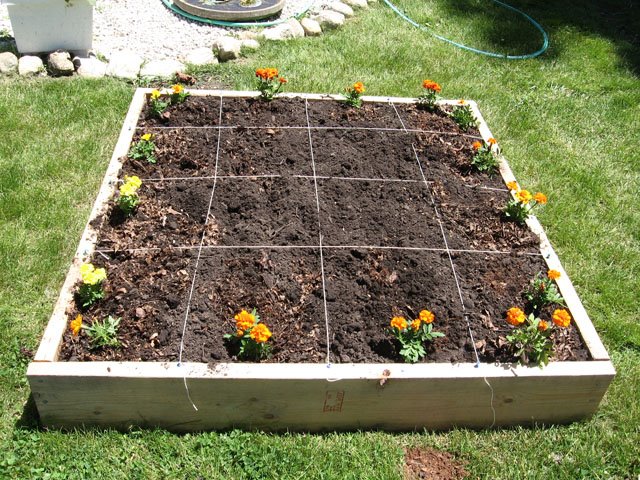
Bed Ready to Plant

Once the grid is completed the bed is now ready to plant. There are some rules regarding the density. For example in 9 beans can be planted in one square. Density charts are available online. I use companion planting and observe those rules as well. Generally what goes together grows together. There is an earlier post on companion planting if you need to find out more.

Marigold Border

This bed is the last of three new vegetable beds so is destined to be an overflow bed for this year. Raised beds often need a year to become well established or at least that has been my experience. I don't expect the same results from new beds as the older beds. Once the raspberries are finished fruiting they will be moved to this bed so it will become a small raspberry patch. It will still be planted with companion plants to raspberries using the square foot method.

Well that is about it on construcing a square foot garden bed other than at some point depending on what you are growing you may need plant support. You can use trellises or even homemade designs. My beans are supported by a hockey goal post design using cotton yarn for them to climb on. Be creative!

Happy Gardening

Garden Gnome


Monday, June 19, 2006

Epsom Salt - A Gardener's Solution!

Epsom Salt

This 100% natural mineral is a gardener's solution! Epsom Salt is maganesium sulfate and it can be used to get great results in the garden as well as a soak for aching muscles after a day in the garden.

General Use: Mix 1/2 c epsom salt per gallon of water for watering potted plants. Apply 1 tsp per foot of height for each plant once biweekly.

Tomatoes: Add 2-3 tbsp per hole before planting then twice a month, sprinkle 1 tbsp per foot of height per plant biweeklyy.

Roses & Flowers: Use 1/2 c in the soil at the base of the plant then uses a foliar spray of 1 tsp epsom salt to 1 gallon water or use 1 tsp per foot at base biweekly

Peppers & other fruits and vegetables: Miz 1 tbsp per gallon of water and water monthly or us one tsp per foot of height per plant biweekly.

Outdoor plants & shrubbery: Use 1-2 tbsp around base of plants every 2 - 4 weeks.

Gardener's Dream for Tired Muscles: Dissolve 2 c epsom salt in warm tub of water. Relax while pondering seed catalogues.

Happy Gardening

Garden Gnome


Thursday, June 15, 2006

June 15, 2006 - Take Pictures!

You never know what you are going to see in your garden. If you do a 15 minute walk about of your garden as I do twice daily, you might see just about anything from the critter that is eating your beans to a wide variety of critters just visiting your garden. Pictures tell more than words so if one of your plants is doing something odd take a picture for troubleshooting. If you find an undentified insect or plant and want to know whether it is friend or foe take a picture. Chances are very good someone else has encountered that problem or insect. However pictures are not just for troubleshooting. Get close-up of your plants. Add the pictures to your garden journal along with your comments. For that reason I make it a point to never go into my gardens without a camera!

Happy Gardening

Garden Gnome


Monday, June 12, 2006

June 12, 2006 - Garden Savings

There are so many ways to save on gardening but I thought it might be a good idea to highlight some of them. I think there are four main aspects: environment, cost, time, and effort. So I'll mention a few of the things I do to save in all aspects.

Environment:
As gardeners I firmly believe we are stewards of the land. That means we should do nothing to harm the land and we should encourage as natural of an ecosystem as possible. In essence we should leave the land better than we found it. Since we are planting things that don't normally grow wild we still need to encourage birds, butterflies, beneficial insects and etc. At the same time we need to control the harmful invaders if we want a crop so we need to find a balance. My rule of thumb with any type of pest control is to use the least harmful method possible. In some cases this is fencing when dealing with the larger animals but it is environmentally friendly. My second rule of thumb is organic as near as I can get. Our lot backs onto farmland so I can't be sure his sprays don't get on my garden but I can be sure that I haven't put any sprays on the garden. But there are other ways to save environmentally.
Establish a compost whether it be bin or pile. Compost is just good all the way around. It gives nutrients to your plants, retains moisture in your beds, and get rid of garden and kitchen waste making it the perfect recycled ingredient. For the past few years I've used a very simple pile method. My municipality had a special on compost bins for $25 so I decided to pick one up. I'll still run the pile because the garden has expanded enough to need more compost. Composting is a must!

Water! It amazes me how we take water for granted even for our gardens. Then it boggles my mind that someone will tell me their garden is organic even though they are using municipal water. Hello! That water is treated and in many areas still has both floride and chlorine in it when it comes out of your tap. I've designed water barrels to collect rain water of which I will be posting a step by step method of constructing them. So check back here for those instructions. Those with ponds will know that pond water makes great fertilizer while watering your gardens. If you have fish in your ponds do not use the water for edible plants. Your flowers and lawn will love it. I maintain a water feature or two in my garden.

Cost:
There are just so many ways to save on gardening. I think this might warrant a separate post. Get clippings or seeds from others which is why I'm trying to start a seed exchange on my yahoo group. Take clippings and save seeds from your own plants. I have heard others have had luck with bargain priced seeds. I can't comment on this. However check back here as I will make a post just on saving money.

Time & Effort:
Sometimes together and sometimes not but they always seem to fall together. You either have a lot of time and no effort or visa versa. I think one of the biggest bains of gardening is weeding. So here is my method. I do a complete walk through the garden morning and evening. It takes me about 10 minutes and as I go I pull any noticeable weeds. I might deadhead a plant or check for insects. The important thing is keeping a close eye for any problems. It also is a nice way to start the day and end the day. Now 10 minutes doesn't seem like a lot of time but it is more than enough to keep any weeds under control and check for any problems. Sometimes I'm in the garden several times a day. I always pinch, weed, deadhead, and observe because I know it saves me a lot of time and energy later.

Happy Gardening

Garden Gnome


Monday, June 05, 2006

Baby Birds & Bunnies

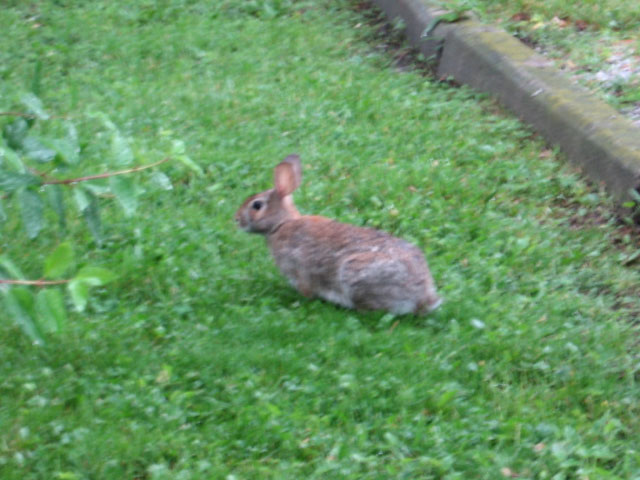
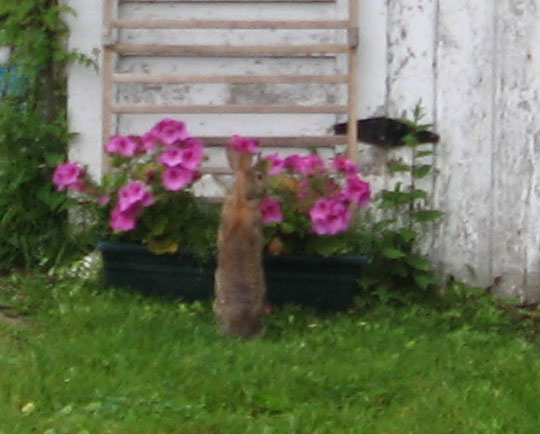
One of my first blog posts was about bunnies. We have a healthy and abundant jackrabbit population. From experience, the jackrabbit population is cyclic. Last year they never bothered with my vegetable garden or if they did, I never noticed. This year they like the garden and have quickly become a problem. Not so much "they" just one very persistant young one. Young rabbits are like teenagers - no fear and very defiant!

Rabbit

I left the greenhouse light on, left a radio playing and turned the motion activated spray to very sensitive. This little guy danced to the oldies while taking his shower and munching on salad! So I added bone/blood meal to the garden beds as apparently they don't like the smell. I can't really blame them! I also added a large plastic owl to the bed the rabbit seems to prefer.

Plastic Owl

So far so good in the vegetable garden. But yesterday I looked out and what did I see - the young one and either a friend or family member! They were "in" the window box planter on the ground planted with Martha Stewart geraniums.

Rabbit in Windowbox

Apparently they like safflower seed even though they aren't supposed to like it and they thought the window box was a perfect stool for them to sit on. I liberally applied cayenne/powdered pepper mix to which they thanked me and asked for more. My luck they will make friends with the owl and get him dancing to the oldies as well. Heaven help me if they discover the slugs' beer. I give up!

We are fencing the vegetable gardens keep the rabbits out. The original vegetable bed has a gravelled holding path and area for hardening off plants. The greenhouse is in the corner of this area followed by three raised beds perpendicular to the greenhouse and two raised beds perpendicular to the three beds forming a large rounded on one corner gardening area. I really like the design and flow of the garden. We decided to add three 4' x 4' beds that originally were going to sit along the side of the garage. Now, my husband thinks it would be best to align them along the holding path creating a regular path there and adding a new holding bed so the greenhouse will be sitting about a third of the way into the garden with raised beds on both sides. He thinks it will be easier to fence. The boxes have been constructed for awhile so it is only a matter of adding soil later today. We'll remove the border rocks then extend the paths to the west. I intend to put in a small gated arbour then 3'rabbit proof fencing along with a 8" wide raised bed running along the entire perimeter to be planted with marigolds. So another year of gardening additions begins!

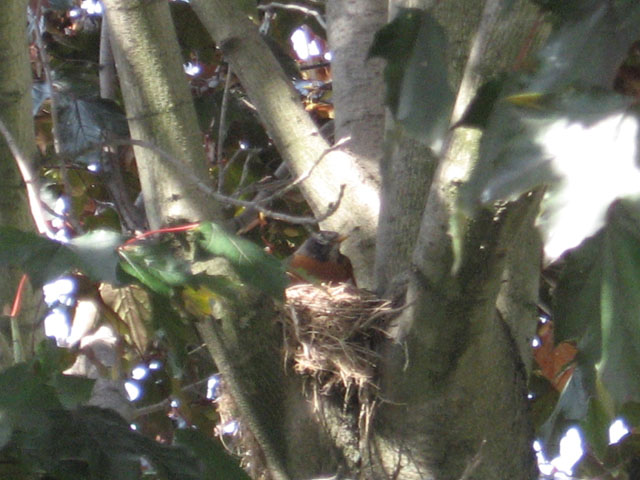
During the spring I watched a pair of robbins build a nest in our maple tree so I wasn't surprised to see part of a robbin eggshell under the tree.

Robbin's egg

My husband had been planning to trim the tree but agreed to leave it be until the babies left the nest. I had the advantage of being able to view the nest from one of our front windows. Both parents were very agressive towards other birds to the point I had to stop feeding the bluejays peanuts.

Robbin on Nest

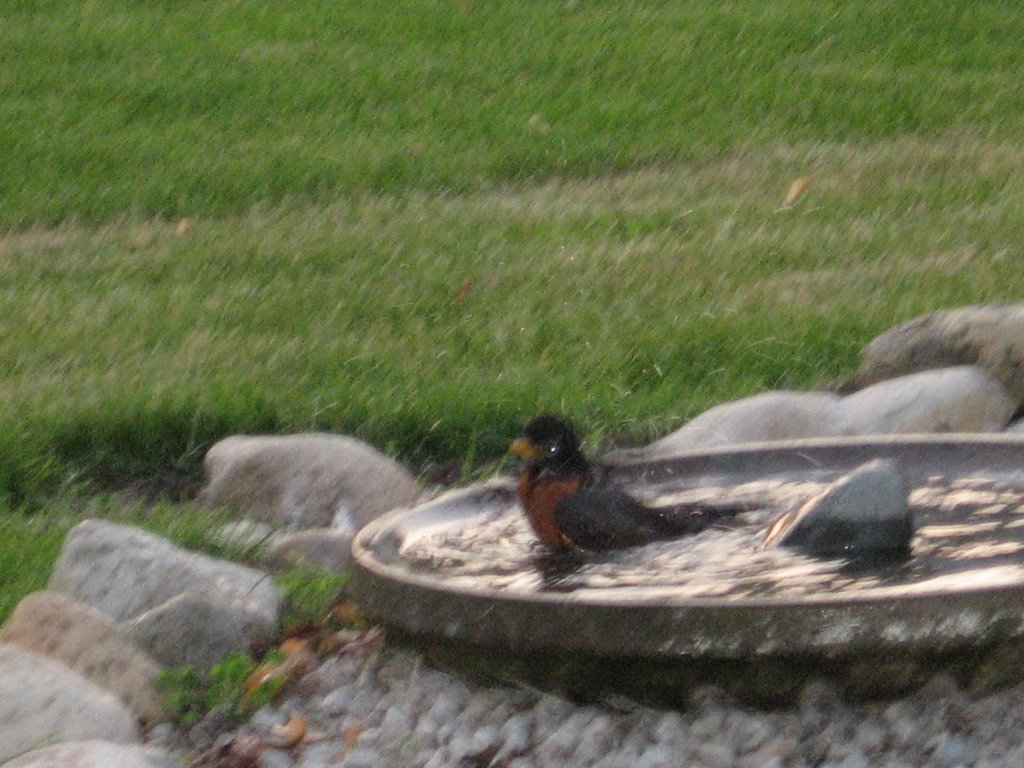
They even went after the squirrels! For some reason they didn't attack the sparrows likely because they didn't see them as threat. The male robbin likes to follow me around when I water the garden and he will let me get quite close to him. It is a rather funny sight so I've been told. He stays about four feet behind me the entire time I'm watering. Both robbin parents really appreciate the garden bird bath. They are regular visitors in the garden and despite other reports that robbins can do tomato damage, I have yet a problem with robbins.

Robbin in Birdbath

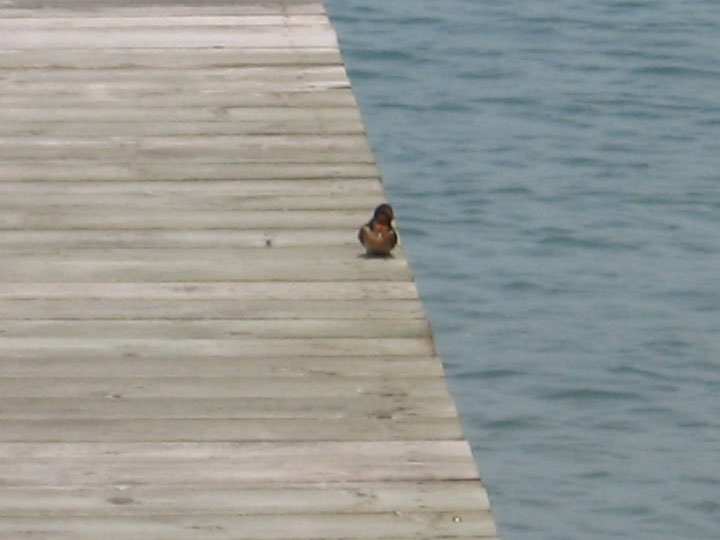
We have swallows on our dock. When they are nesting they create a real problem by swooping low towards your head usually three or four at a time. This basically makes the dock unusable for about a month so a lot of people use plastic owls to prevent them from building a nest in the first place. These staunch little birds stand guard allowing no one onto the dock or even near it. They will immediately take flight and swoop at your head as soon as you try to go onto the dock.

Swallow

I tried to ward them off this year by putting that same plastic owl on the deck for a morning. The swallows were so distressed I just couldn't leave it out there as there were likely babies in the nest. A couple of days later I managed to get on the dock to see that there were a couple of babies. I'm so glad I removed the owl! My neighbour says a swallow's nest brings good luck and I can use all the good luck possible.

Yesterday, I noticed the robbin's nest was very quiet. By now it is apparent the babies have flown the coop. While I'm glad they are old enough to fly I was saddened that the nest was empty. Then this morning I noticed the swallows are no longer standing guard. Their offspring must have flown the coop too.

Happy Gardening

Garden Gnome


Monday, May 29, 2006

Watering Tips

Watering can be the single most make or break of gardening. Improper water whether too much, too little or at the wrong time can spell disaster. So here are some of my watering tips most of them learned through trial and error. They are by no means perfect and you will have to adapt to your situation.

Timing:
I prefer to water in the early morning before the full force of the sun hits the plants. Water acts as a magnifyer to the sun's rays causing sun burn on the plants. Watering in the morning also helps them get through the heat of the day. The only time I water during the heat of the day is if I see a plant in distress. Most times this is a container plant that dried out too quickly. Then I hand water the soil not the plant. I have watered in the early evening after a very hot day to give my plants a little pick-me-up but I'm always sure to water early enough that any wet foliage is dry before nightfall. Sometimes raised beds just like containers need a little extra water. Watering at night without time for the foliage to dry encourages mold and fungus. Wet soil encourages snails and slugs.

Amount:
I think this is one of the critical points to watering. Make sure you water enough but not too much! A brief spraying isn't going to do any good. It will create demanding plants with shallow roots. Too much water will create water logged soil and unhappy plants dying from root rot. So you need a happy medium. In general water once a day but only if needed. Soak the soil well but don't oversoak. For containers that means soak until water runs out the drain hole then stop. My rule with my raised beds is when I see small puddles I know that is enough water. You really have to dig into the ground to see how far the water has penetrated to determine how much to water with raised beds but once you've watered them a few times you will instinctively know. A rain guage is handy when watering raised beds. Watering both raised beds and containers are different than watering traditional in the ground gardens because the soil is controlled but the principles are the same. My neighbour has a large in ground vegetable garden. He handwaters if necessary but seldom uses the hose and never a sprinkler. Basically he let nature take its course. Then he complains his garden doesn't do well. OTHO, I have over producing raised beds watered regularly but not always daily depending on the weather.

Weather:
Sorry but if you are going to garden you need to pay attention to the weather. That means learning to read the skies and keeping in tune with your local conditions. I have found true the the sailors warning is true and being a boater I heed that warning, there is no point watering my garden if the sky is red in the morning. If the night is clear and there is a ring around the moon, don't water because rain is coming! If the leaves on your trees especially maple are turning over, don't water because it is going to rain. I can smell when it is going to rain because of increased ozone in the air but some can't pick up on this smell. My bones ache when it's going to rain too so that is another sign. In our high tech days, sometimes we fail to notice these signs. As gardeners check your weather report and planting guide daily but also learn some of the old ways to help you with your watering needs.

Water:
We are under water restrictions here allowing for watering every other day. I devised rain barrels to help with the watering if needed. We live on the water so we could always cart water to the gardens but that is rather a pain as would pumping water to the gardens. Rain barrels are inexpensive and easy to set up. Get a 50 gal plastic drum and remove the lid. Add a spiggot with hose attachment near the bottom if desired (preferrable). Test you spiggot for leaks "before" continuing. Turn the barrel right side up and attach window screen to the top of the barrel. This will keep debris and leaves out of your barrel. Place your barrel near your downspout. Cut downspout and/or redirect into the centre of the barrel. Wrap chicken wire around the barrel and secure. Now, push the barrel into place. The downspout should be in the centre of the barrel. Plant vining plants of your choice such as ivy or clematis around the base of the barrel. These will grow up the chicken wire masking the barrel. When your barrel gets about half full, add feeder goldfish or ruby red minnows to control mosquitoes. Now you have an inexpensive but visually appealing water barrel to help your watering needs. There are two ways to use your barrel. Hook up a soaker hose or hand water. If you have access to a natural source of water which we do you can either cart water or hook up a pumping system if allowed. Some municipalities will not allow you to do this but most will. If you can it will provide a nutrient rich souch of water hopefully chemical freee. At any rate any type of water souce for your garden should be used to its full potential without wastage. Municipal water is easier to use but conservation is still necessary. In most cases there is a charge for municipal water.

Methods:
This is by far the largest area to differ on. I like easy methods that don't waste water and for that reason I "prefer" soaker hoses. They can be concealed by mulch or ground cover. Once in place they only need to be hooked up and used with draining in the winter if you are in an area that freezes in winter. No muss, no fuss and easily adaptable to the water barrel. They best part is of all watering methods they put the water where it is needed and reduce evapouration and wastage. Second to that I use hand watering for the vegetable gardens consisting of a multi-sprayer set to shower. In the greenhouse I use the mist or shower setting but my son is experimenting with a drip system so that might be changing very soon.

Hand watering by watering can works well too. It is more time consuming but can be a great diversion for a restless young one :) I still very much enjoy watering this way. My neighbour still does it this way the majority of the time.

Sprinklers waste a lot of water through evapouration, large coverage area and they soak the foliage creating problems you don't want such as mold and fungus especially if used in the evening. There is a tendency to overwater because you walk away then forget the sprinkler is on. The problem is they are a cheap and easy solution for the novice gardener. So most of us have at one time used them and some of us still do. I think a rain guage is important when using a sprinkler. Water to your desired amount in the guage then turn the sprinkler off. While a sprinkler is an easy solution, try to use it only when necessary.

Containers present their own problems because they can dry out so fast. I use the shower setting with the hose but have come up with a couple of other ideas. I'm testing my sons drip system on a couple of plants so if that goes well I'll post the instructions. So far so good. I use the wick method on other container plants. Simply take a plastic container like a sour cream container. Fill with water. Poke a hole in the top and tread synthetic wick through it long enough to reach the bottom of the container. Put the lid on the container. Push wick up through the drain hole of the pot to near the surface. Set pot of reservoir (plastic container) and the plant will water itself for about a week. Use larger reservoirs for larger containers.

Miscellaneous:
While you are considering water, add a water feature or a couple of bird baths. You want to encourage birds, butterflies, and bats into your garden. They all need water. There are several ways of doing this of which I won't go into detail now. Keep your bird baths clean. Change the water daily! Add the sounds of water flowing buy using a smal recirculating pump and air tubing to create a fountain or bubbling water. Birds are drawn to the sounds of tinkling water. The sound is rather pleasant while you pull weeds in the garden :)

Happy Gardening

Garden Gnome


Monday, May 22, 2006

Attracting Butterflies

Butterflies are a beautiful sight in the garden but more important they are pollinators so should be encouraged in your garden. Some decide to plant a specific garden to attract butterflies while others like me encorporate butterfly attracting plants and elements into the garden. I plant marigolds aroung the perimeter of one of my raised beds that is home to tomatoes, peppers, onions, and lettuces. Marigold is the perfect companion plant for these vegetables for pest management yet they are perfect for attracting butterflies! Many herbs and flowers are perfect companion plants. Most will deter the damaging pests yet encourage the beneficial allies.

Here's my number one rule: if you want butterflies, don't use pesticides indiscriminately! Instead rely on natural insect control like companion planting, toads, birds, bats, lady bugs, rosy red minnows and parasitic wasps. Keep your plants healthy by proper watering, not over crowding them and regular fertilizing to help ward off insect infestations. If you really must use some form of pest control, try the simplest solution first like manual removal. If that doesn't work, use Safer's Insecticidal Soap or a homemade solution of 2 drops liquid soap, 2 drops vegetable oil dissolved in 1 quart water. The homemade insecticidal soap is likely the strongest chemical I've used in my garden in the past four years. With that being said, here are tips to attract butterflies to your garden.

Butterflies are insects that go through a complex life cycle: egg to caterpillar to chrysalis to butterfly. It is important to recognize the stages of the butterflies you are trying to attract so you don't inadvertedly destroy them. It is also important to understand that there may be some foliage damage ranging from minor to severe during the caterpillar stage. There are two ways to deal with this problem. Plant some sacrificial plants, remove the caterpillar to those plants and let them be or plant a special butterfly garden away from your vegetable garden. You can simply manually remove and destroy which is not the best solution but sometimes may be the only way to save your favourite crop.

Butterflies need the basics including a food source for caterpillars, full sun, sheltered areas to reduce wind, water, and nectar for the butterflies. The most successful butterfly gardens bloom from early spring to late fall. Include native plants in your garden including some weeds like milkweed and thistle. Emphasize red, yellow, orange, and purple single blossom flowers. Here are the top 20 plants that butterflies love: aster, bee balm, butterfly bush, butterfly weed, cardinal flower, cosmos, globe thistle, goldenrod, joe pye weed, liatris, lilac, marigold, mexican sunflower, phlox, purper coneflower, scabiosa, stone crop, sunflower, yarrow, and zinnia. Other plants include members of the carrot family, cleome, clover, dill, dogwoord, hollyhock, milkweed, snapdragon, thistle, violet, and willow but be aware that certain caterpillars will feed on the foliage. Night blooming plants are attractive to many moth species.

Butterflies are cold-blood so like to bask in the sun. Add flat stones to a sunny spot in your garden for them. Male butterflies like a wet patch of mud or sand for "puddling" and will often gather in large groups to lap up the minerals. Use a shallow dish or birdbath to provide water for butterflies.

Here's my second rule: take pictures! Get close and personal but get those pictures not only of the butterflies but any other life stage you can find. Some caterpillars are absolutely gorgeous! Keep details such as when to discovered the butterfly, caterpillar or chrysalis along with what plant you discovered it feeding on. This will help you fine tune your butterfly garden.

Happy Gardening

Garden Gnome


Saturday, May 20, 2006

Deer!

Sometimes you can't win for losing. Now I haven't seen the deer myself or any indication there have been deer in the gardens but my neighbour three doors down has some really nice pictures of deer in his back yard. I'm not really sure what to do. I've been fighting the wild rabbits and think I have them under control. I sat in the garden until dark and saw no signs of deer then spred more mothballs around the perimeter and the garden pathways as well as turned the motion activated sprayer up to full tilt. I fear that if deer are in the immediate area, I might just as well shut down the gardens. I'm not sure how else to deal with it. We would need at least a 6' fence and I honestly think if we decided to fence we would add some type of topper to keep all the larger animals out.

So far the garden looks good. There is no sign of any type of damage from any animals although we know something larger was in the garden a couple of nights ago. A larger bucket was overturned the next morning. It was large enough that a squirrel or even large bird could not have done it and I doubt even a rabbit but could be. I'm going to try a radio playing in the greenhouse along with the mothballs and the motion activated sprayer. Time will tell if I'm sucessful.

Garden Gnome


Tuesday, May 16, 2006

A Walk Through My Garden

Come take a walk through my garden. This is a longer post with a lot of pictures. Relax and enjoy.

One thing that you will notice as you walk through my garden are dandelions. We live on the water and have a field behind us. Dandelion control is a lost cause. I don't like to use herbicides that could get into the water so the dandelions stay. Yet in some ways they are a welcomed sight in the spring with their cheery yellow blooms. We enjoy the untreated dandelion leaves in salads.
Dandelion You will also notice lots of little garden decoration whimsy and flowers in the vegetable garden. We have little ones that love to find a surprise hiding under the leaves of growing plants. I love flowers in the vegetable garden as well so that's where you'll find them.

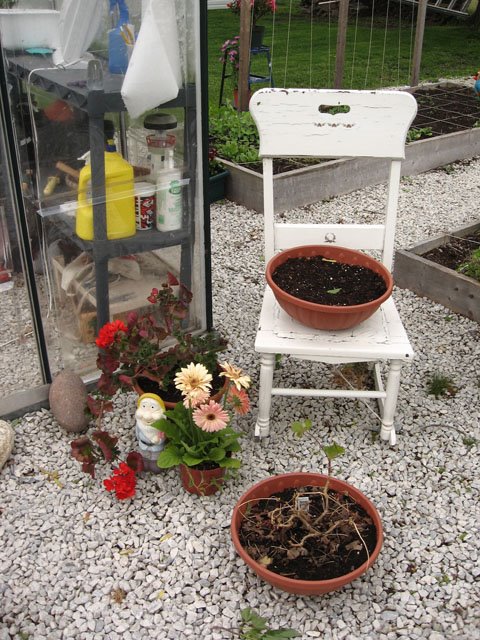
Greenhouse The greenhouse is the focal point of the garden. It is a small 6' x 8' hobby greenhouse. I grow some plants to maturity as well as start a lot of seeds in the greenhouse. I opened up the greenhouse in March. It really gets too cold to leave the greenhouse operational during the dead of winter. However, by March it was warm enough the nigh temperatures in the greenhouse stayed just above freezing.

I've had an old rocking chair in the garden for some time now. I think it signifies Mother Earth. It makes a lovely spot to set potted plants.
Rocking Chair Last year I had geraniums on the chair. This year the geraniums are sitting beside the rocker and I have marigolds planted in the pot on the rocker. So far there is no sign of seedlings yet.

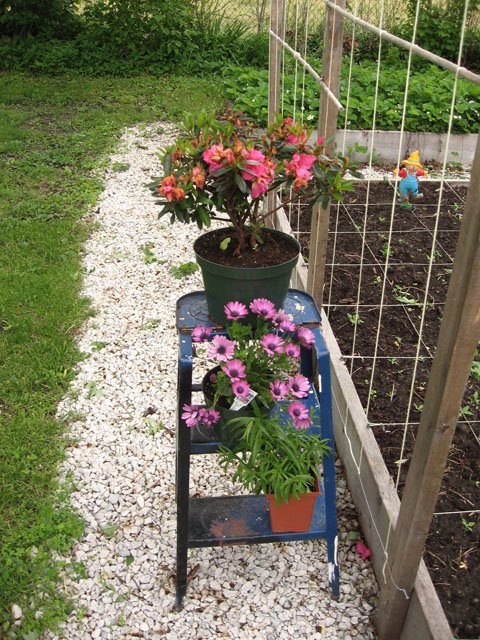
I'm short and the pole beans grow to about 8' on trellises so I need a step stool in the garden. The pole beans are grown in bed #3.
Step Ladder I figured that since the pole beans haven't been planted yet but the ladder was out I might as well put it to good use. The potted flowers will be moved when the ladder is needed.

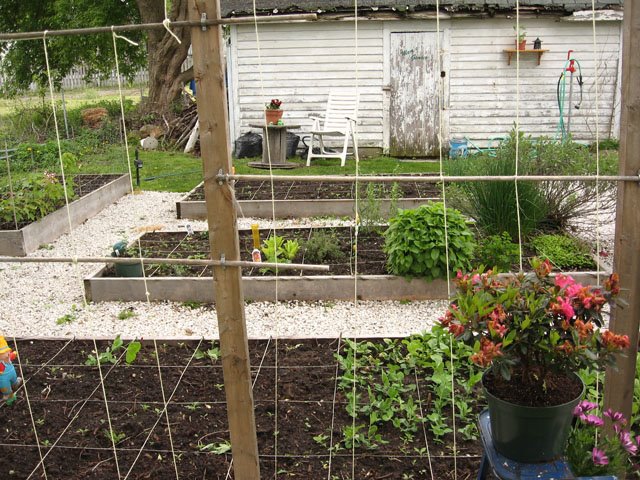
The main vegetable garden is planted in raised beds. Each bed is planted in a particular fashion using companion plantings. Bed #1 holds tomatoes, peppers, and onions. Bed #2 is home to herbs while beans and peas are grown in bed #3Beds # 1 - 4 Bed #4 is completely filled with June bearing strawberries. It wasn't meant to be this full but they filled in the bed so we have just left it.
Beds #1, 3 and 5 Beds #1-3 are 4' x 10' while beds #4 and 5 are 4' by 8'. The beds include companion planting that includes some flowers like marigolds, nasturtiums, and petunias as well.

Bed #1 and 5 This picture was taken just after tomatoes were planted. The marigolds haven't been planted yet. At the front of bed #1 there is a window box of panseys outside of the bed followed by lettuces and onions in the bed. It will be another couple of weeks before we can plant the various peppers in this bed. Later, as the tomatoes grow my husband will add the removable A-frame trellis that supports the tomatoes. Another 16 tomato plants will be planted in a new raised 4' x 4' bed outside of the main vegetable garden.

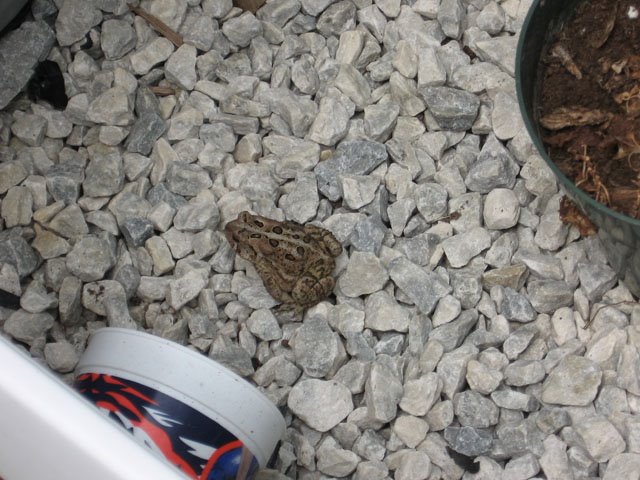
Toads are special and are welcomed in my garden anytime. They can eat an incredible amount of insects in a evening! For that reason, I don't use pesticides such as Sluggo. This type of pesticide will go through the skin of toads, killing them.
Toad So I was thrilled when I found one little guy decided to take up residence in my greenhouse. Then looking around the greenhouse I found another toad trying to get into the greenhouse. I must be doing something right to be blessed with toads.

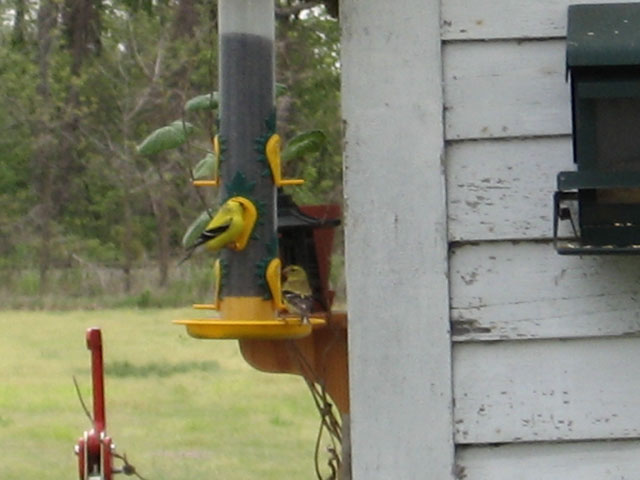
I mentioned in a previous post how I try to attract birds to my garden. Well, these little guys love niger seed so I have a feeder special for the smaller birds. The easiest way to control the types of birds in your garden is through choice of seed followed by choice of vegetation.
Goldfinches I put up one feeder on the shed wall then filled it with a corn mixture. That was a huge mistake something I realized after chasing off two wild rabbits. I should have known better! I changed that seed to black oil sunflower seed only to be bombarded with starlings and grackles. Somehow the cowbirds missed it. The starlings are so aggressive that they chase away the song birds so I changed the black oil sunflower seed for niger seed, something the starlings don't seem to like. However, that is rather expensive so I'll be replacing the niger seed for safflower seed. Safflower seed will attract the song birds as well as cardinals. So I have three bird feeders all aimed at attracting songbirds without creating a problem by attracting unwanted critters. On feeder holds sunflower seeds. It is squirrel and large bird proof. The hopper birdfeeder will hold safflower seed to attract more song birds and the tube feeder is aimed directly at the finches.

I hope you enjoyed the walk through my garden.

Garden Gnome


Saturday, May 13, 2006

Come Wander Through My Garden Thoughts :)

Where do I begin? This entry is more of a mish mash, or wandering through the garden. We were on vacation in Las Vegas and arrived home mid Thursday morning. I think I worried the entire time we were gone about the gardens even though I knew they were in very good hands. My son took the seedlings home to baby them while my neighbour took care of the main vegetable garden beds and the greenhouse. When we left Las Vegas it was 94 o to arrive in Detroit at 60o and rain. Then we drove through blinding rain to get home! Despite lack of sleep I was itching to get out into the garden so was a little disappointed when the rain refused to let up.

Yesterday brought more rain. I wanted to get the beans planted but there wasn't enough of a break in the rain. So I contented myself with online research and tidying up my shopping list. Now this is just not a good time of year for me! Honestly, I'm not a shopper until it comes to plants. That means I "have" to stop at every nursery or garden spot for miles around. That means I end up with more plants than I really need. My son picked up the seedlings from my other son so they are back in the greenhouse. He also picked up wood for a 4' x 4' raised bed except he got pressure treated instead of plain spruce. So that bed will be used for flowers or shrubs only. The plants brought indoors are also back in the greenhouse and the electricity has been re-connected.

I woke late this morning to more rain. Drat! So I decided to at least do a little work in the greenhouse. It wasn't much but at least I made a list of exactly what plants I have so I wouldn't inadvertly buy duplicates. Then I went shopping at the local vegetable stand. The have nice, healthy plants! I bought a couple of hanging baskets of petunias, sweet peppers, ultra sweet tomatoes, big beef tomatoes, and coleus. My son arrived with enough wood for 3 more raised 4 ' x 4' beds. He assembled the beds but they are still empty until my husband can give his input as to location. At the moment they are forming a diamond pattern that is rather appealing. That means another 48 sq. ft of grass gone withouth the other 16 sq. ft bed to be planted with flowers. If it were up to me I'd have no grass at all. I seriously hate grass! It is boring yet in some cases high maintenance. I'd like to turn the front yard into a wildflower bed essentially eliminating all grass. This just might be the year.

The main vegetable garden beds are doing remarkably well! The peas will need staking shortly. The lettuces and radishes are promising to be bumper crops. I need to take pictures of both. The herbs are doing well too. Unfortunately the unplanted squares have attracted a few weeds but that will be easy to remedy. I planted asparagus the day before we left for vacation but there is no sign of growth.

I posted about bird feeders so thought I should follow it up with this comment. Choose your seed wisely. It will determine not only what birds eat at your feeders but also what wild life the droppings might attract. I feed the blue jays daily with a handful or two of unshelled peanuts. They take everything within a very short time so the peanuts don't attact any wild life. However, I filled the one feeder with a generic mix that included corn. This really wasn't too smart as the day we were leaving two wild rabbits were happily munching away at the droppings while the starlings/grackles fought to see how much they could spread the seed. My husband emptied that feeder before we left and I filled it with black oil sunflower seed today. Another feeder holds black oil sunflower seed but only the smaller birds can get to it and a third holds niger seed. The first feeder with be changed for safflower seed. The cardinals and smaller birds like safflower but the starlings do not like it at all. If you research the birds in your area, you will find out what attracts them. If you find one seed is attracting unwanted attention from certain birds or other critters, change the seed.

Chives! I'm going to do a whole post on the topic of chives but for the time being, chives are already being cut here. These are almost like weeds. You can't kill them and they spread like wildfire. However, they are the ultimate addition to so many dishes so I grant them a little lee way. This year I split my chive section up. I ended up with a half barrel, two large pots and I'm giving away chive plants. Even if you don't eat chives it is one of the easiest herbs to grow and it is very pretty. I love the flowers!

Well, now that I've wandered, I really need to sit down and do a little more planning. I'm garden shopping again likely in the morning but if not Monday morning. I really, really, really "need" a new garden gnome! My old one is looking a little ratty but he'll just get moved to another spot in the garden. I was rather proud of myself this year. I love garden decorations as long as they don't interfer with the function of the garden. This spring I tossed out a lot of garden decorations that either were too ratty or no longer met my needs. However, a garden gnome is a must :)

Happy Gardening

Garden Gnome


Tuesday, May 02, 2006

Birds, Butterflies and Bats

Too often we focus on the garden pests without paying much attention to the beneficial garden visitors. These visitors should be encouraged as they help keep garden pests under control. They are a sign of a healthy garden. Make your garden a haven for these visitors. Don't use pesticides!

Butterflies:
You can't have butterflies without the caterpillars that will do some foliage damage but you can attract them to your garden along with a plant or two you are willing to use as butterfly bait for the caterpillars. Put these plants just slightly away from your main garden bed. Carefully remove any offending caterpillars to the appropriate bait plants. This will allow them to mature to the butterflies you want without destroying your crop plants. Plant flowers to attract butterflies. Marigolds and petunias are especially beneficial as companion plants in the garden and should be planted throughout the garden. In general butterflies like red, yellow, orange and purple single blossom flowers. Some herbs like dill, echnacia, and yarrow will attract butterflies. I had a swallowtail caterpillar last year so have already planted a pot of parsley to transfer any caterpillars to this year. If possible, plant a few milkweed plants to attract Monarch butterflies. Other great butterfly attactors are aster, bee balm, members of the carrot family, cleome, clover, dogwood, hollyhock, snapdragon, thistle, violet, and willow. We are very lucky that we have a nice patch of wild violets!

Birds:
Birds can be very beneficial in the garden. I always hang at least one bird feeder and plant sunflowers for the birds. This is for the seed eating birds but anyone who has ever fed birds know that each variety of birs will attract otheres including the insect eaters like woodpeckers. We have a lot of sparrows. I have caught them on more than one occasion eating insects and spiders around the windows even though they love to eat from the feeders too. House and gold finches seem to prefer the feeders. We have at least three blue jays each with their own personality. They prefer unshelled peanuts and sunflower seeds. They are very entertaining birds especially when they are chasing squirrels out of the garden. Larger birds like the common grackle, robin or larger crow will take care of grub problems and they will help keep caterpillars under control. They seem to be attracted by other birds! If you are lucky you will attract a hawk or two. Hawks will go after the smaller birds but more importantly they will keep the rodent population in check. Owls will do the same thing. Attracting birds to you garden is easy keep in mind the basics of food, water and shelter. You will need to provide one or more feeders and keep them filled. Birds need to know they have a secured food source. For best results use squirrel-proof bird feeders unless you want to go through a lot of seed very quickly. Add a water source. Try to mimic natural water puddles by placing a shallow bird bath at ground level in a shady spot. If cats are a problem, raise the bird bath a couple of feed and keep it away from shrubs. A small pump can be used to create the sound of tinkling water. This will help attract birds and provide a soothing sound in the garden. The final thing needed to attract birds is shelter preferrably natural as in shrubs and trees. Add nesting boxes (bird houses) and nesting material.

Birds add an entertainment aspect to the garden. We live on the water so have the benefit of enjoying water fowl as well as song birds and birds in general. I think all birds are song birds after observing them so long. Some have songs that are prettier than others. Our water birds include many varieties of duck, tundra swan, Canada geese and the ever almost annoying cliff swallow. They have nests under our dock so I have some really nice pictures of the babies. However, for their size they are vicious little birds swooping within inches of your head if you try to use the dock before the babies leave the nest. My neighbour says they are good luck so they stay. The water birds don't bother the gardens with the exception of the swallow but only if they have a nest nearby. Some birds like my blue jays have their own personalities. Big Blue sits on the porch railing waiting for his daily peanuts. If they don't come fast enough he moves to the window sill where he will peck at the window until I toss out his peanuts. Little Blue sits on the eavestroph watching this closely and always manages to scoop up a few peanuts before Big Blue does. Neither are concerned over the door opening. Robins have their own personality as well. One robin decided to ensure his worm supply last year by following me around the garden when I watered. He'd stay about 4 feet behind me and followed me everywhere as long as the hose was on. We thought this was hilarious so my husband video taped him. Birds are welcomed in my garden anytime!

Bats:
Bats are very beneficial in the garden. Some eat frogs, small mammals, fish and nectar but the majority of bats in a typical garden eat insects. The common brown bat can consume several hundred mosquitoes in a night as well as moths and beetles that can do a lot of damage in your garden. Mature trees provide roosting spots for bats. If you don't have mature trees install a bat box. Build the bat box from wood, and stain them brown to help retain the heat. Bat boxes should face south. Boxes smaller than 20 inches across by 24 inches tall likely won't be used. Chambers can be made using wood slats. Bat boxes should be mounted on the side of a building at leat 12 feet from the ground. Provide a water source larger than an average bird bath so the bats can swoop and grab a sip while flying.


Monday, May 01, 2006

Odds and Ends

I really enjoysunrises and sunsets so I take a lot of pictures of them. This morning, the sky was threatening rain. The clouds were heavy enough to wipe out any sunset. I pondered the gardens while sipping on my morning coffee disappointed there wouldn't be a gorgeous sunrise to great the day. One thing I've learned living on the water is nature never disappoints. The water constantly takes on a life of its own. Today was no different.
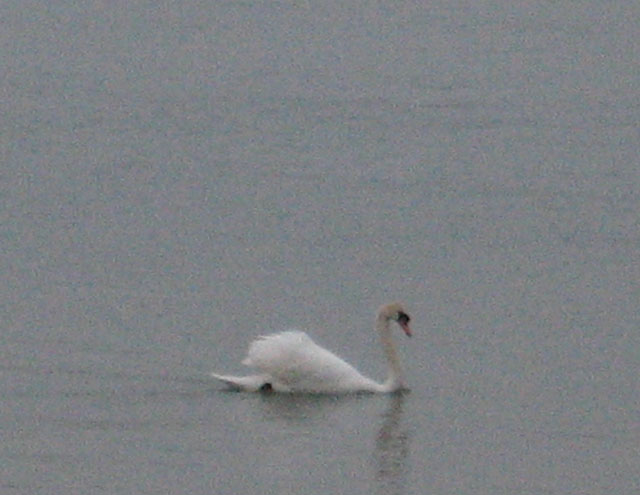
Tundra Swan
Three tundra swans swam by so I couldn't resist taking a couple of pictures. The lighting was a little too low an I used the zoom so the picture is a little grainier than I would like. One of these days I will get the perfect picture of them but for now I'm just happy they blessed my day.


I just realized that while I've talked about my gardens, I haven't really posted pictures of them. I have five raised beds planted in the square foot method. I use push pins to attach cotton yarn to form the grids. This picture was taken a sunrise a couple of days ago. Sunrise is one of my favourite times of the day. Here you can see part of bed #1, bed #2, bed #4 (strawberries) and bed # .
SFG beds
The grids remain for the entire growing season. A particular vegetable is destined for each square. Each bed has a specific use though. Squares are replanted as needed so most of the time the beds are rather full.


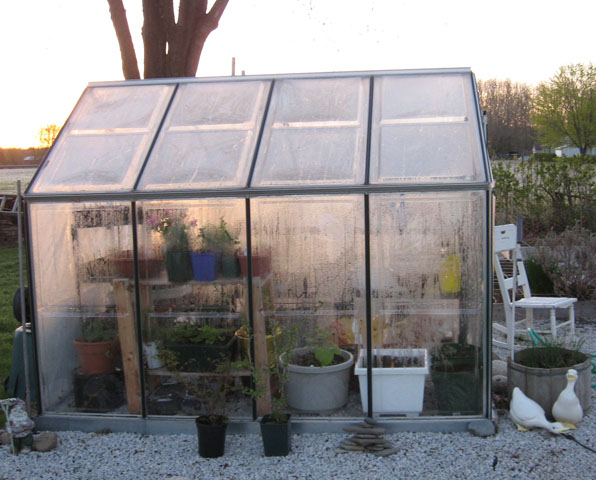
I have a love hate relationship with the greenhouse. I wanted it so bad yet didn't know that most times I would be fighting it. It does extend the growing season by about a month on each end. However, because of its size, it is difficult to heat properly in cold weather and overheats in July and August. Last year, we cleared it out for the summer months. Still it is useful and a beneficial addition to the garden. Here are a couple of pictures of the greenhouse.
Greenhouse at Night
Until the past week or so, I used a 150 watt grow bulb to light the greenhouse. Being energy conscious, I changed that bulb out to a 26 watt CF floodlight. So far I haven't noticed any problems with the plants.
Sunrise on the Greenhouse


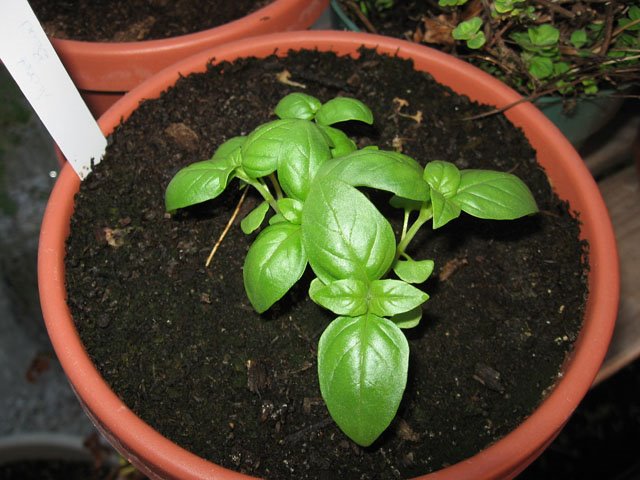
Basil is one of my favourite herbs. Each year I experiment with different basils but always grow sweet basil. Basil pesto freezes well and basil makes a really nice vinegar.
Sweet Basil
This year I'm growing purple basil, cinnamon basil, sweet basil and lemon basil. Basil is an annual here so I start the seeds in the greenhouse. When frost threatens, I bring the basils into the house to enjoy a little longer. Unfortunately, basil tends to get leggy indoors so usually by mid January, the plants aren't very good. A little tip for basil is to root it in water. Take a snipping from the main basil plant. Fill a jar with water then cover with plastic wrap. Poke a hole in the plastic wrap to put the snipping then wait for it to develop roots. Either leave as is or pot in soil. This is one way to extend your basil yield.


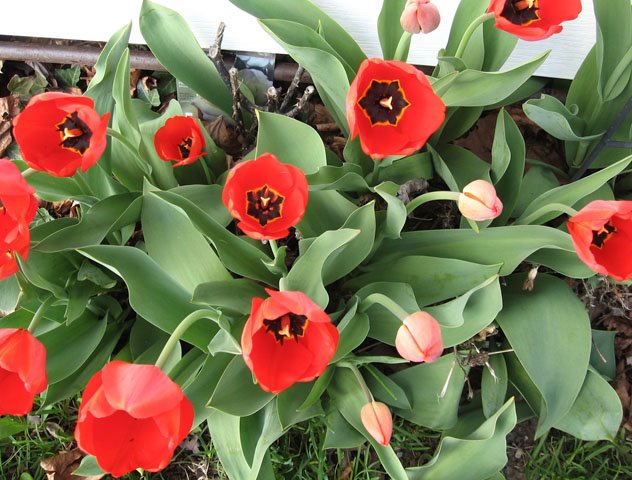
I love tulips so they grace along the south side of the house. They make me smile as they wave gently in the wind. I was very concerned today as the house was being power washed. I know the service is professional and know what they are doing but that didn't stop me from worrying.
Tulips


Sunday, April 30, 2006

Thoughts on Watering

Watering is a concern that comes up every year. Everywhere I stopped for plants this week the common complaint was lack of snowfall that translates into it is already too dry. I'm already preparing to deal with another hot dry summer. Last summer was so hot and dry that watering was almost a daily chore. The problem was we are under a watering restriction so can only water every other day. This seems rather funny since we live on the water and could easily cart water from there but unless we are desperate we don't. I physically can't cart the water myself anyway. One solution my neighbours have come up with is to pump water from where it is to the gardens. This is a round about way of getting around the water restrictions because they aren't using municipal treated water. I decided to do it a little bit different.

A rain barrel is the perfect solution and if done correctly eliminates the need for using any treated water on your gardens. I've found using two rain barrels and rotating them to be fairly effective. We added a hose attachment near the bottom so the barrels work passively. The threat of West Nile Virus is a concern and standing water attracts mosquitoes so we control the mosquitoes naturally in the barrels. Rosy red minnows or feeder gold fish are an inexpensive solution to the mosquito larva and they add nutrients to the water so it becomes a cycle. Instead of screening, add floating plants to the barrels. They will help keep the water clean and allow fresh rain water in creating a nice little ecosystem. Your garden will reward you with increased yields!

Watering restrictions are a pain yet watering naturally can be rather pleasant. Yet no type of watering system is going to be effective if you don't water properly.

First take a good look at your soil. The soil mixture should contain enough organic matter to hold water longer. If not, seriously look at ammending your soil. This is so important when growing in raised beds or containers! The soil must be light and fluffy for both raised beds and containers, in my experience. That means you may need to add one of more of the following: peat moss, compost, humus, wood ash and in some cases vermicullite or perlite. There is a relative new product out called a water gel. I've seen it under a couple of brand names. It's been available for years but only recently in bulk for larger gardens. This gel absorbs water then slowly releases it back to the soil. The nice thing about this gel is it is non-toxic and regenerates when watered however, it is expensive. The main problem I see with the gel is it gives nothing to the soil as far as nutrients so why use that when you can add something that will add nutrients. Once the water is on your gardens, you want to keep it there to some degree. You want a nice balance of enough water yet well drained soil. This is where mulch comes in.

Mulch helps keep the soil moisture while still allowing drainage. In general you will have to find the mulch that is right for your garden. Pine needles raise the acidity so using them as a mulch on plants that don't grow well in these conditions is not a good idea. Black plastic will work but will also raise the temperature of your bedsl. While this may be desirable in the spring, it will work against you during the summer months. Newspaper will work too just be careful not to use glossy paper. I tried straw and found it to be somewhat helpful but messy especially for planting. Personally, I don't use any mulch that will not give something back to the soil in terms of nutrition. The best solution I have found is a 1 - 2" layer of chopped of leaves replenished as needed. My husband uses a leaf vacuum in the fall that chops the leaves up into small bits. We store these in garbage bags over the winter allowing decomposition to begin. Then I add them to the raised beds as needed. The leaves add organic matter and bulk to the soil. I figure since nature put them there, I might as well use them.

When watering, use a soaker hose and water at the base of the plants. Don't waste water using a sprinkler. The water is wasted and the plant leaves get too wet opening up problems for fungus especially if you water too late in the day. Improper watering will just add more problems.

Extended periods away from your garden can really be a watering nightmare. An automated watering system or a very good neighbour can help with this situation. I prefer my neighbours because they garden themselves so will be on the lookout for any other problems. However, the wick method of watering works well for containers and lessens the imposition on the neighbours. The greenhouse watering would really be an imposition so when I know we will be away more than 24 hours, all the plants in the greenhouse are moved into the house where one of my kids keeps them watered.


Saturday, April 29, 2006

Planning and Prepping Thoughts

It's that time of the year when the stores start getting in their new gardening stock and I'm just itching to buy it all! I'm drawn to the plants like a moth to a light bulb. Surrounded by all the wonderful plants, I just have to buy whether I have a spot for them or not. I'm totally mesmerized as one plant after another is crowded into the cart. The sights, the smell and sometimes hairbrained ideas that "this would be good" just kick into high gear. That explains why I have only one gooseberry bush even though we've never had gooseberries. It didn't get planted last year because I had nowhere for it. Somehow the plant survived the winter in the pot so it will be planted shortly. It also explains why I have two new raspberry bushes, rhubarb, and asperagus with no real spot for them but I had to have them. My husband is more of the "do you have a spot for it" type person. This raises the important issue of planning and prepping gardens long before you start seeds or buy plants.

I got my first seed catalogue the first part of January. After browsing through it, I decided to limit myself to three or four new fruits or vegetables. Without a limit, I would seriously buy everything in sight. I knew I wanted rhubarb because it is seldom in the stores or fruit stands. I also wanted raspberries because when available they are aweful expensive. I knew I wanted to grow more herbs and basically turn raised bed #2 into herbs only. In the back of my mind, I had a vision of how I wanted the vegetable garden this year so I decided to do some research.

The first thing I came upon was Garden Manager 3.05 by Jonathan Maier. This is a slick little program based on Square Foot Gardening by Mel Bartholomew. Other years I had simply drawn out each bed then penciled in the square with no attention to companion plantings. This year I was deterimined to do things in a more organized manner. My three large beds are 4' x 10' giving 40 squares. The two smaller beds are 4' by 8' giving 32 squares. After researching, I decided I wanted to use more companion planting and change my methods a bit to include fertilizer. Armed with what I wanted, it was time to start playing with Garden Manager. This program made things a lot easier. Each bed was laid out according to the square foot method then each square filled in so when planting time comes I know exactly what to plant in each square. I even specified the variety since I grow more than one variety of some vegetables. This is the general plan for my three largest beds:
Bed #1 - tomatoes, peppers, lettuces, onions, marigolds planted around the perimeter
Bed #2 - herbs, some lettuces if necessary
Bed #3 - peas, beans, carrots, lettuce, cucumber, spinach, marigolds, petunias
The two smaller beds:
Bed #4 - strawberries
Bed #5 - maple trees, beans, peas, ground cherries, cucumber, zucchini

With the main beds planned right down to when to plant certain vegetables based on the ALFD (average last frost date), I could tweak and turn my attention to what to start in the greenhouse as well as the rest of the yard. We have a very large, water front lot at about 250' deep. I couldn't keep it looking nice without some type of planning. The main problem was whether to add more raised beds or not along with an arbour for grapes. I still need a spot for the rhubarb, gooseberries and raspberries. This is an ongoing debate that hopefully will be settled by the end of next week.


Friday, April 28, 2006

Rabbits

If you have ever had rabbits in your garden, you will know where I'm coming from. Mind you they are cute but they can destroy a garden in almost no time with their grazing habbits. Aside of members of the onion family, I think they will eat just about anything! I've battled them ever since gardening but here they tend to be a little more numerous as the picture shows. However, being well trained in population genetics, I know the local rabbit population is cyclic. That is, some years you won't see any signs of them but other years they are everywhere. This year appears to be an abundant year for rabbits likely due to the very mild winter we had. At any rate, rabbit control is in order.

My neighbour tries to trap the rabbits but rabbits don't take well to going into the live traps. Our animal control suggests using a net if you can get close enough. Now anyone who has ever dealt with a wild rabbit will know that getting close is rather difficult and if you finally get the rabbit in a net it is going to hurt itself and likely you along with it. I don't think this is a really good option. In previous years, I have found a mixture of cayenne and powdered pepper to be effective but since I think this harms the animal, I only resort to this when all else fails. I really prefer to use measures to encourage the rabbits to move along and eat elsewhere without harming them. I have a motion sensor sprayer calle "the scarecrow" that does seem to be rather effective. It give a blast of water, about a cup, along with a funky noise to scare the animal away. I do know it is effective for racoons and squirrels. Given the rabbit population boom this year, my neighbour feels my sprayer while effective, will not be effective enough and I agree. So a little online search gave a few interesting results.

One bed has already been protected with chicken wire. All the beds are raised so the chicken wire was stapled around the entire bed. Aesthetically, I find this solution unappealing but if that is a last resort, so be it. The chicken wire rises about 2' above the bed. It makes working the bed more difficult but at least it doesn't hurt the animal.

Apparently, sprinkling mothballs around the perimeter of the garden will keep rabbits away. This is a cheap and easy method but I would not use it where kids visited the garden. These things look like mints so I would be very concerned a child would pick them up and eat them. I would not use them directly in the garden beds either since I wouldn't want the chemical getting into my produce. However, my neighbour and myself are trying out the moth balls along our pathways. I'm still concerned though so will try the experiment for one week the remove any remaining mothballs. I really am not comfortable with this idea. I'd prefer staying as chemical free as possible!

Rabbits also don't like bone meal so I picked up a box of that yesterday. At worst, the gardens get a little extra fertilizer and at best, it will keep the rabbits under control. Unlike the cayenne pepper treatment or mothballs it is chemical free and can help the gardens.

I also picked up a canister of Critter Ridder. This is a repellant that helps with dogs, cats, raccoons, skunks, and groundhogs. While the label does not specify rabbits, I think it should work. One treatment is good for 30 days so will be more effective than the pepper treatment that has to be reapplied every time it rains. I intend to use this only if necessary and only around the perimeter of the garden. I really hope I don't have to use this treatment!

The final plan aside of shooting them (DH's idea and not one I would tolerate) is to install electric fencing. I think the cheapest out there is called Fido and is sold at pet stores for about $50. In the long run it might be the cheapest solution. It might be awkward climbing over the fence and aesthetically I'm not so sure about. I think you could do it nicely without being too intrusive.

The saga of the rabbits continue...


Wednesday, April 26, 2006

Garden Pests Part 1

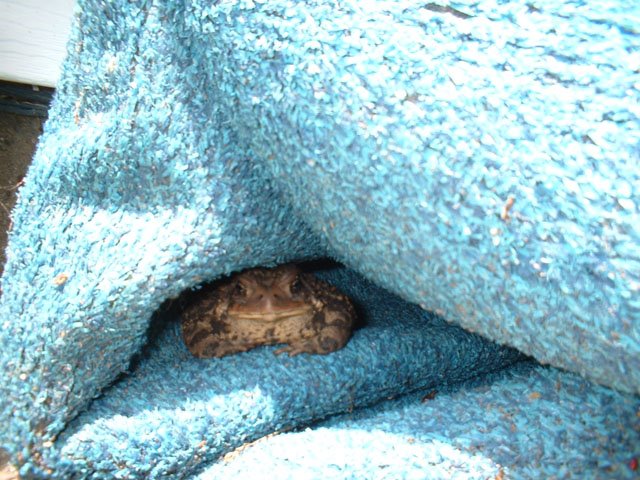
I take a rather laid back approach to visitors to my garden. Here's a picture of a cute little fellow that took up residence in a piece of rug my husband was supposed to put on the patio. He stayed with us until the fall giving my husband the perfect excuse not to put the rug down.
Mr. Toad

Other visitors are not so welcomed. We've had a problem with wild rabbits. They are kept out of the garden by using a motion activated sprayer called "the scarecrow" and in the case of one bed, I used a short height of chicken wire surrounding the bed. In the early spring when the threat of a heavy frost was quite real, I used a mixture of cayenne and powdered pepper. I don't like using this solution if at all possible. We've had a problem with other pests as well.

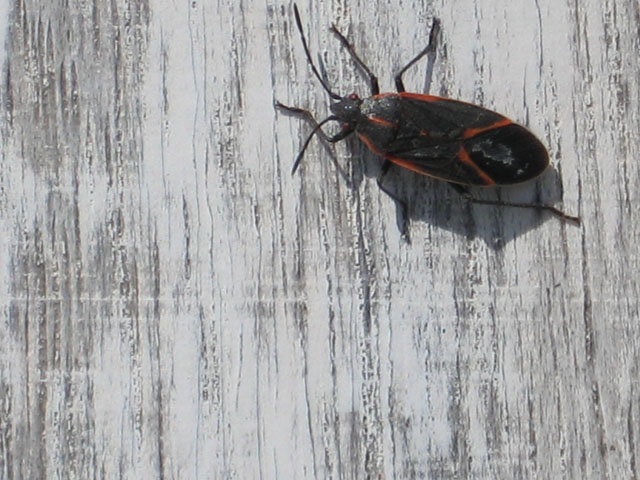
The box elder bug is more annoying than damaging.
Box Elder Bug
They hang around the garden having sex all day creating more of the little critters. If they get in your house or greenhouse they leave nasty little marks over everything. A solution of 3 - 4 drops of liquid dish soap mixed with water then sprayed on them gives an almost instant kill. It is about the only way to control them and even then it will not rid your garden of box elder bugs once infested. Controlling is the only way to deal with these little pests.

Caterpillars can be quite damaging in the garden especially the cabbage worm. Since I try to avoid pesticides where possible, I control caterpillars manually by removal. I didn't get a picture of the cabbage worms that destroyed my broccoli crop. The tomato hornworm can be destructive if left unchecked. While tomatoes are the primary target, this caterpillar will feed on peppers and potatoes. A natural enemy of the tomato hornworm is the braconid wasp that lays eggs on the caterpillar. The larva feed on the tomato hornworm until they are ready pupate. If you see white projections on the tomato hornworm it means it has been infected by the wasps so it is best to leave it in the garden. If no white projections are apparent, manual removal will prevent further damage.
Tomato Hornworm

The swallowtail caterpillar can descimate parsley or any member of the carrot family in a relatively short period of time, eliminating your entire crop. While the caterpillar is rather pretty it had to go! I've heard that removing these caterpillars to anise will save the parsley but since I didn't have anise growing last year, the caterpillars were simply removed. The funny thing is I never noticed any swallowtail butterflies around the garden and I do tend to take notice of garden visitors. This year I plan to take a different approach. Any swallowtail caterpillars will be removed from the main herb bed and place on parsley grown in pots just for them. That way I will be able enjoy the caterpillar, butterflies, and my parsley!
Swallowtail Caterpillar

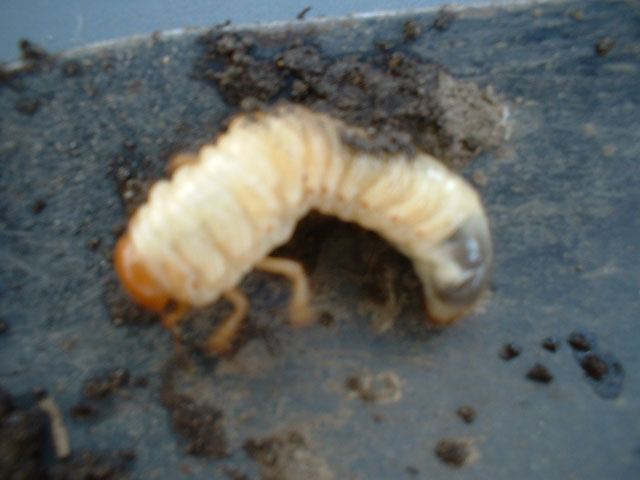
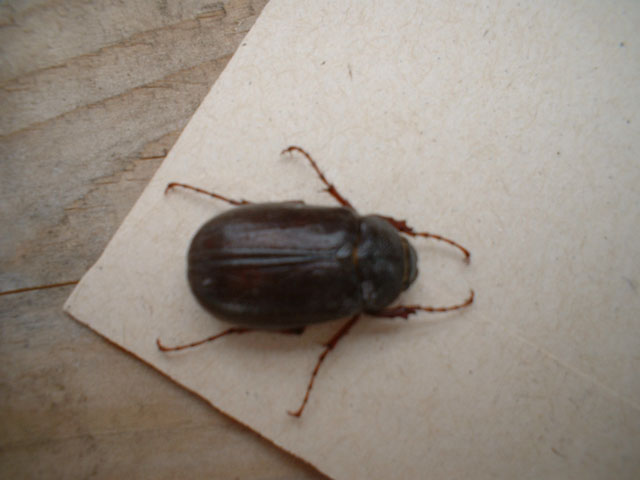
White grubs are really the bane of lawns. This grub will mature to become a June Beetle. Natural enemies of the grub are small mammals such as skunks and birds. Encouraging skunks in the garden might not be the most prudent thing to do so grub control is necessary. June Beetles are large chesnut brown beetles that look rather menacing. For the most part, I really don't get too hung up on them. Last year they showed up in the raised beds. Manual removal worked best without using any pesticides.

grub
June Beetle

I'll post my further adventures on garden pests in part 2.


Tuesday, April 25, 2006

Privacy Policy


GARDEN GNOME WANDERINGS

PRIVACY POLICY


Welcome to Garden Gnome Wanderings (the "Site").

We understand that privacy online is important to users of our Site, especially when conducting business.
This statement governs our privacy policies with respect to those users of the Site ("Visitors") who visit without
transacting business and Visitors who register to transact business on the Site and make use of the various services offered by Garden Gnome Wanderings (collectively, "Services") ("Authorized Customers").

"Personally Identifiable Information"
refers to any information that identifies or can be used to identify, contact, or locate the person to whom such information pertains, including, but not limited to, name, address, phone number, fax number, email address, financial profiles, social security number, and credit card information. Personally Identifiable Information does not include information that is collected anonymously (that is, without identification of the individual user)
or demographic information not connected to an identified individual.

We use third-party advertising companies to serve ads when you visit our website. These companies may use information (not including your name, address, email address, or telephone number) about your visits to this and other websites in order to provide advertisements about goods and services of interest to you. If you would like more information about this practice and to know your choices about not having this information used by these companies, click here.

What Personally Identifiable Information is collected?
We may collect basic user profile information from all of our Visitors. We collect the following additional information from our Authorized Customers: the names, addresses, phone numbers and email addresses of Authorized Customers, the nature and size of the business, and the nature and size of the advertising inventory that the Authorized Customer intends to purchase or sell.

What organizations are collecting the information?
In addition to our direct collection of information, our third party service vendors (such as credit card companies, clearinghouses and banks) who may provide such services as credit, insurance, and escrow services may collect this information from our Visitors and Authorized Customers. We do not control how these third parties use such information, but we do ask them to disclose how they use personal information provided to them from Visitors and Authorized Customers. Some of these third parties may be intermediaries that act solely as links in the distribution chain, and do not store, retain, or use the information given to them.

How does the Site use Personally Identifiable Information?
We use Personally Identifiable Information to customize the Site, to make appropriate service offerings, and to fulfill buying and selling requests on the Site. We may email Visitors and Authorized Customers about research or purchase and selling opportunities on the Site or information related to the subject matter of the Site. We may also use Personally Identifiable Information to contact Visitors and Authorized Customers in response to specific inquiries, or to provide requested information.

With whom may the information may be shared?
Personally Identifiable Information about Authorized Customers may be shared with other Authorized Customers who wish to evaluate potential transactions with other Authorized Customers. We may share aggregated information about our Visitors, including the demographics of our Visitors and Authorized Customers, with our affiliated agencies and third party vendors. We also offer the opportunity to "opt out" of receiving information or being contacted by us or by any agency acting on our behalf.

How is Personally Identifiable Information stored?
Personally Identifiable Information collected by Mom's Cafe Home Cooking is securely stored and is not accessible to third parties or employees of Mom's Cafe Home Cooking except for use as indicated above. TrafficAgentServer 1.01

What choices are available to Visitors regarding collection, use and distribution of the information?
Visitors and Authorized Customers may opt out of receiving unsolicited information from or being contacted by us and/or our vendors and affiliated agencies by responding to emails as instructed, or by contacting us at sfg.oamc@yahoo.com

Are Cookies Used on the Site?
Cookies are used for a variety of reasons. We use Cookies to obtain information about the preferences of our Visitors and the services they select. We also use Cookies for security purposes to protect our Authorized Customers. For example, if an Authorized Customer is logged on and the site is unused for more than 10 minutes, we will automatically log the Authorized Customer off.

How does Garden Gnome Wanderings use login information?
Garden Gnome Wanderings uses login information, including, but not limited to, IP addresses, ISPs, and browser types, to analyze trends, administer the Site, track a user's movement and use, and gather broad demographic information.

What partners or service providers have access to Personally Identifiable Information from Visitors and/or Authorized Customers on the Site?
Garden Gnome Wanderings has entered into and will continue to enter into partnerships and other affiliations with a number of vendors.
Such vendors may have access to certain Personally Identifiable Information on a need to know basis for evaluating Authorized Customers for service eligibility.
Our privacy policy does not cover their collection or use of this information.


Disclosure of Personally Identifiable Information to comply with law. We will disclose Personally Identifiable Information in order to comply with a court order or subpoena or a request from a law enforcement agency to release information. We will also disclose Personally Identifiable Information when reasonably necessary to protect the safety of our Visitors and Authorized Customers.

How does the Site keep Personally Identifiable Information secure?
All of our employees are familiar with our security policy and practices. The Personally Identifiable Information of our Visitors and Authorized Customers is only accessible to a limited number of qualified employees who are given a password in order to gain access to the information. We audit our security systems and processes on a regular basis. Sensitive information, such as credit card numbers or social security numbers, is protected by encryption protocols, in place to protect information sent over the Internet. While we take commercially reasonable measures to maintain a secure site, electronic communications and databases are subject to errors, tampering and break-ins, and we cannot guarantee or warrant that such events will not take place and we will not be liable to Visitors or Authorized Customers for any such occurrences.

How can Visitors correct any inaccuracies in Personally Identifiable Information?
Visitors and Authorized Customers may contact us to update Personally Identifiable Information about them or to correct any inaccuracies by emailing us at sfg.oamc@yahoo.com

Can a Visitor delete or deactivate Personally Identifiable Information collected by the Site?
We provide Visitors and Authorized Customers with a mechanism to delete/deactivate Personally Identifiable Information from the Site's database by contacting sfg.oamc@yahoo.com. However, because of backups and records of deletions, it may be impossible to delete a Visitor's entry without retaining some residual information. An individual who requests to have Personally Identifiable Information deactivated will have this information functionally deleted, and we will not sell, transfer, or use Personally Identifiable Information relating to that individual in any way moving forward.

What happens if the Privacy Policy Changes?
We will let our Visitors and Authorized Customers know about changes to our privacy policy by posting such changes on the Site. However, if we are changing our privacy policy in a manner that might cause disclosure of Personally Identifiable Information that a Visitor or Authorized Customer has previously requested not be disclosed, we will contact such Visitor or Authorized Customer to allow such Visitor or Authorized Customer to prevent such disclosure.

Links:

This web site contains links to other web sites. Please note that when you click on one of these links, you are moving to another web site. We encourage you to read the privacy statements of these linked sites as their privacy policies may differ from ours.


© 2006- 2009 Garden Gnome Wanderings , All rights reserved.

Unauthorized duplication or publication of any materials
from this Site is expressly prohibited.


Get your own Privacy Policy here!


Why I Became Interested in Gardening

Someone asked me why I became interested in gardening. The simple answer is "why not"? Honestly, at some level I've always been interested in gardening. So here are some of my earliest memories.

My Mom had flower gardens and vaguely I remember her putting in a vegetable garden one year when I was very young. It must not have worked because the only edible thing I can really remember her growing was rhubarb. I loved the looks and smells of the rich earth mixed with the heavenly smell of flowers. I would sit for hours reading in the lilac tree. Willow trees were awesome once I learned how to swing out over the river but Mom quickly put a stop to that. I was surrounded by nature, animals and loved every minute of it. But this one front bed was different. The only thing I liked about it was the glass chunks. I can remember gazing into the glass chunks that decorated my Mom's small flower garden, imagining there were meramaids swimming in them. She always planted geraniums in that bed. I hated the smell of geraniums! They were worse when she brought them in for the winter resting spot on my bedroom window sill. I still hate the smell of geraniums but I have since learned to appreciate them. While Mom didn't really vegetable garden I learned a lot of canning skills from here, so maybe my childhood experiences set the path I was to follow. Fast forwarding a bit, is when I think vegetable gardening first became a real interest.

We lived in an apartment building just after marrying. A nice, elderly neighbour lady would lived on one side of the entrance to the apartment building had a cherry tree. It is from her I learned how to make cherry pies. It is also from this couple that I first really marvelled at having a vegetable garden. It was gorgeous! Neat little rows of vegetables ran the length of their garden. That year I tried growing tomatoes in a container. I wasn't suscessful but that didn't stop me from trying.

Over the next few years were were busy raising kids. I'd put flowers in yet it wasn't until our second house that I planted grapes and strawberries. The following year we planted a small patch of tomatoes and peppers. So it was for the rest of the time we lived there. We sold that house and moved to a smaller house with a huge front yard but almost non-existent backyard but by now my interest in vegetable gardening had really been sparked. I was limited to two small 2'x8' strips behind the garage for growing vegetables. I quickly learned that growing vegetables vertically gave a higher yield. The internet provided a wealth of information on small space gardening so I kept trying different things. Even though some were met with failure, the successes encouraged me to try again. Then we moved here.

Now I have as much room as I want for gardening. Yet I still love the raised beds and square foot gardening method. Both remove a lot of the work of gardening. This will be our fourth vegetable gardening season here. My methods have changed slightly and I continue to use container gardening for those spots we don't want permanent raised beds. Each year I try three or four new vegetables but some staple vegetables always remain.

I still love the smell of newly turned soil. Vegetables growing give me an undescribable pleasure. I've found that by using the square foot method, flowers can be incorporated into the vegetable gardens. My favourite glass chunk from childhood still graces my garden and the mermaids still swim when I gaze into the aqua glass.


Welcome to Garden Gnome Wanderings

Welcome to my blog. Here you will find my adventures in gardening, cooking and anything else that strikes my fancy.
I thought creating a blog of my gardening and cooking adventures would be fun so here I am. For us, these activities go hand in hand :) Now where do I begin? How about a bit of an introduction?

We live in Ontario Zone 6A. For the most part, I do all of the gardening but my husband helps with anything heavy or any construction as needed. Our vegetable garden consists of five raised beds planted in the square foot method and a small greenhouse. All beds take advantage of companion plantings. Vegetables are also grown in containers to help maximize our growing area. We have used this method for three years and while it is working well for us, we feel we can boost our yields by incorporating a few changes.

This year we are planning a few changes. We are adding three smaller 4' x 4' beds also planted in the square foot method. We may add two 2' x 8' beds in an area that needs to be escuvated anyway. In previous years we have relied on compost to ammend the soil in the raised beds. This year we will also be using fertilizer on a regular basis in the raised beds this year but will refrain from chemical pesticides and herbicides as in previous years. We ammended the beds with peat moss and manure. Although sawdust is recommended for the one small gardening method, we have had no luck finding any untreated sawdust. Another change for this year was starting the planting much earlier.

So far, we have planted peas, onions, radishes, spinach and lettuces outside directly in the beds. One bed has always been for strawberries and that will remain. Another bed is mainly for herbs, a change from last year. The greenhouse gets fuller each day awaiting the last frost date for planting. This week, beets, carrots, chard and potatoes will go in. We've had a few days of rain so I'm just waiting for a dry enough time to plant them.

Well, I think that sums things up in the garden. The activity in the kitchen is gearing towards this year's growing season. Much of the canning has focused on soups, stews, and beans. I canned up a lovely batch of bean and bacon soup on Saturday. This week's canning will be mushrooms. I buy mushrooms in bulk from a mushroom farm usually 20 lb at a time. While we prefer fresh mushrooms, a few jars of canned mushrooms are nice to have on hand. Asparagus will be starting soon. I haven't canned asparagus in the past and I'm not sure if I will try this year. It might be good to have a few jars on hand to make cream of asparagus soup. Frozen asparagus generally has a better flavour and texture though. So that's it in the kitchen.

I started two yahoo groups, garden_wanderings and lets_cook that allow discussion for those interested in these topics.
Subscribe: garden_wanderings-subscribe@yahoogroups.com
Subscribe: lets_cook-subscribe@yahoogroups.com
My yahoo blog will be similar to this one for some entries but in general will vary. You can find it at: http://ca.360.yahoo.com/sfg.oamc

I'm off to discover this blogging adventure. Thanks for stopping by.