Neighbours talking over the garden gate has long been a tradition. They share gardening tips, complain about the weather and pests yet are ever eager to discuss their gardens. That is what I had in mind when creating this blog. So stop by my garden gate to find out the latest happenings in my garden.

Happy Gardening!

Garden Gnome
"All my life through, the new sights of Nature made me rejoice like a child." ~ Madame Marie Curie"
Showing posts with label flowering shrubs. Show all posts

Wednesday, July 27, 2011

Hibiscus

hibiscus
Hibiscus
July 25, 2011

I really have a rubber arm when it comes to plants.  I was in WalMart (Canada) a couple of days ago when a plant sale caught my eye.  Three foot tall hibiscus were on sale for $5.  Now that is a wonderful price so I bought two.  I wanted them as container plants on each side of our front door.  Since our house is on the market I have been focusing on container gardening this year as all the containers will move with us.  We do have an active offer so if it goes the way we want it too we could be moving on August 25.  Anyway, back to the hibiscus.

I popped the plants into larger display pots, cut a tag off, watered them then came in.  Hibiscus prefers a bright location but according to the tag it says to never allow them to get below 50ºF.  So obviously I am not going to be able to plant these trees in the ground even at our new house.  One of the hibiscus is slated to go to my husband's office.  It is a wonderfully bright area with excellent morning sun exposure so I'm sure the hibiscus will thrive there nicely.  The other one will be outside on our deck at the new house but brought inside when temperatures drop below 50ºF.  The new house is so bright, light and airy so I am looking forward to re-establishing my indoor gardens as well. 

Happy Gardening!

Garden Gnome
©2006-2011


Tuesday, January 25, 2011

Powder Puff Plant (Calliandra haematocephala)

Powder Puff Plant 
(Calliandra haematocephala)
December 16, 2010


As we were wandering through Busch Gardens I couldn't help but notice the Powder Puff Plant (Calliandra haematocephala).  The leaves reminded me of Mimosa (sensitive fern) so I just had to touch them.  They don't fold up like Mimosa does but they were still quite pretty.  The Powder Puff Plant was planted to form a barrier between the walking paths and inner workings of the park so used as camouflage or privacy screening.  The plant is grown for its flower heads that are long red stamens blooming in winter.  The plant is drought and somewhat cold tolerant making it another plant to consider for our new gardens if we move.
Happy Gardening!

Garden Gnome
©2006-2011


Monday, January 17, 2011

Gardenia (Gardenia augusta)

Gardenia (Gardenia august)
Gardenia
(Gardenia augusta)
December 16, 2010


Continuing on with sharing a few pictures of our visiting Busch Gardens in Tampa, Florida here is a picture of a gorgeous Gardenia with the information tag.  I mentioned that many of the plant species within the park had information tags.  Each tag gives the common and scientific name as well as a few details about the plant.    The Gardenia (Gardenia augusta) is an evergreen shrub that presents masses of fragrant white flowers in April and May.  It is a member of the coffee family.  Gardenia is somewhat drought and cold trolerant.  It prefers full sun to part shade.  This shrub would be an ideal addition to our vacation home garden!  Hiding behind the trunk of the Gardenia is one of the many birds that frequent the gardens hoping to be fed by visitors.

Visiting these types of parks can be very informative for the home gardener.  It is difficult to picture what a mature plant, shrub or tree will look like from a picture in a book or online.  More importantly is is difficult to gauge the mature size.  Quite often a home gardener will plant a tree or shrub only to find out it is too big for the intended location when it reaches maturity. 

Happy Gardening!

Garden Gnome
©2006-2011


Sunday, September 19, 2010

Butterfly Bush

butterfly bush
Butterfly Bush
September 16, 2010

We stopped at a Cracker Barrel for breakfast a few days ago.  They had a lot of these gorgeous bushes bordering the parking lot.  As we enjoyed our breakfast I watched a large number of butterflies frequenting the bushes.  I aptly named them butterfly bushes but that likely is not their name.  What I found very interesting is the range of colours in the blooms.  Aren't they just gorgeous?  No wonder the butterflies enjoy them!

Happy Gardening!

Garden Gnome
©2006-2010


Tuesday, August 31, 2010

An Unidentified Shrub

unidentified tree
Unknown
August 28, 2010

A few days ago I was on my daily walk when I spotted this gorgeous tree in bloom.  I would have stopped in to ask the owners what it was but the house is their summer cottage so they aren't there very often.  As it was they weren't there that day since the house was all closed up.  I love the whispy look of this shrub.  I would like to identify it so I know what to ask for at nursery.  I'd like to plant a couple here.  If you know what this shrub is could you please leave a comment?

Happy Gardening!

Garden Gnome
©2006-2010


Saturday, July 17, 2010

Rose of Sharon (Athea) in Bloom

Rose of Sharon
Rose of Sharon
"Athea"
July 13, 2010

The Rose of Sharon is in bloom a bit earlier this year.  The bush has grown nicely apparently appreciating some of the clean out of surrounding bushes and trees we have done over the last couple of year.  I just love the double blooms on this Rose of Sharon!  Apparently the humming birds do too as one has been seen frequenting the garden.

Happy Gardening!
Garden Gnome ©2006-2010


Wednesday, February 25, 2009

Callinadnra emarginata was Please Help Identify


Calliandra emarginata
(Pink Powderpuff)
January 10, 2009

[edited to include updated information, March 2, 2009]

During our vacation in central Florida I spotted this beautiful shrub. Unfortunately there was no one out and about when I took the picture so I could not ask what it was. If anyone can identify this beautiful bush could you please leave a comment? Thanks so much!

Thanks to the help of Sinclair this shrub has been identified. He sent me this link to help me in the identification. Wind also commented that it might be bottlebrush but a search found that bottlebrush Callistemon grows mainly in east and southeast Australia (ref. here). Bottlebrush has a much elongated but similar bloom to the powderpuff shrub. Thank-you both so much for your help! I really appreciate it.

Unfortunately for me this shrub grows best in tropical and subtropical climates so the cooler temperatures of Ontario, Canada especially in the winter months would likely mean the shrub would not survive. For those interested in this pretty shrub, check out the link from Sinclair. It is quite informative. I'm sure this shrub would look wonderful in your garden!

One of the downsides to vacationing is seeing all this beautiful vegetation that I would love to be able to grow. I am going to have to enjoy them while on vacation but the possibility of growing indoors is always a possibility as soon as I can talk my husband into a nice conservatory.

Happy Gardening!

Garden Gnome
©2006-2009


Monday, February 09, 2009

Brugmansia


Brugmansia
January 14, 2009

Overlooking one of the grottoes in Hollis Garden (Lakeland, Florida) was an amazingly beautiful flowering shrub with huge, drooping trumpet shaped flowers. Unfortunately I could not get close enough to see if they smelled as heavenly as they looked. When we arrived home I did a little research to identify this flowering shrub. I would love to grow this pretty shrub if at all possible. It is called Brugmansia or commonly Angel's Trumpet.

Brugmansia is a member of the Solanaceae family and is native to the sub-tropical areas of South America. This flowering shrub reaches a height of 3 to 11 metres. The beautiful trumpet shaped flowers range from 14 to 50 cm in size. The flower colour is white, yellow, pink, orange or red. The flowers have a delicate, attractive scent that has slightly lemony overtones. All parts of Brugmansia are poisonous to both humans and animals and can be fatal if ingested. For this reason some municipalities prohibit the purchase, sale or cultivation of Brugmansia. The shrub grows best in moist, fertile, well drained soil in full sun to partial shade, in frost-free climates. Unfortunately our little corner of the earth in Zone 6A is not frost-free so I likely will not be able to grow them. At three metres high the shrub would be to large to bring indoors as well so I will have to settle for enjoying them when we are in Florida.

Happy Gardening!

Garden Gnome
©2006-2009


Monday, June 16, 2008

Peonies (Paeonia)

When the peonies bloom it pours. That has been so true this year with a cold and very wet spring. We had two lovely peony bushes at my childhood home. I loved the beautiful showy flowers so when we bought out first house I really wanted to plant peonies. What stopped me was remembering the ants that liked to gather on the peony buds. An old wives tale says that peonies need ants for the blooms to open but this is a myth. The ants are there to feed on the nectar and will seldom stay after the buds open.


This is the first house that I've had peony bushes. One is a gorgeous pinky white and the other a deep purply pink. Both are very fragrant! They are away from the house so as to not encourage ants indoors. For the most part there is very little maintenance for peonies but they reward you with beautiful, showy, fragrant blooms that can be cut and brought indoors. If doing this and you are concerned there may be ants in the blooms, simply soak the blooms in water for 5 minutes. This will drive out any ants without harming the blooms.

I've noticed two problems with my peonies. First we have been experiencing a lot of heavy rain so that has caused the peony bushes to bend over. They really aren't a stand up type of bush but then it could be where they are planted or just rain damage. Second, there has been a little leaf damage due to slugs. Other than that the peonies are performing nicely. They tend to like cooler climates for best growth.

Peonies should be planted in a somewhat protected location from strong winds, in full sun or light shade preferably with a northern exposure. Fertilize with a 5 - 10 - 10 in the spring. Fertilizing with a higher nitrogen content fertilizer with cause weakened stems and reduced blooming. Peonies bloom late May to mid-June and may not look the best in the fall. Disbudding can encourage larger blooms. To do this remove all buds but the terminal one as soon as buds are visible. Flowers should be removed as they fade just below the flower to prevent seed development. Keep watered and fertilized for best blooms but don't mulch for winter. The soil should be well-drained to prevent root rot. Peonies can be staked to improve the look of the bush but it really isn't necessary. Bushes can be transplanted in the fall but do not plant them too deep. Add 1/4 c of 10 - 10 - 10 fertilizer to the bottom of the hole but not in the soil that will surround the roots. They will take awhile to re-establish after transplanting. Bushes can be divided as well in the fall with more success.

Happy Gardening!

Garden Gnome
©2007


Thursday, May 15, 2008

Lilacs


Common Lilac
(Syringa vulgaris)

May 11, 2006

Lilacs especially the deep pinky, purplish ones are one of my favourite flowering bushes. As a child I used to climb one of our lilac trees and sit in a cradle formed through pruning. Hidden from view and cooled by the dark leaves I spent many a summer afternoon reading. With the exception of our first house there has been at least one lilac bush in every house we've owned. We have a small thicket of common lilac here.

The common lilac (Syringa vulgaris) and the smaller hybrid Persian lilac (Syringa x persica) are large deciduous shrubs that range in size from 2 to 10 m. Originated in Europe and Asia, they became popular in New England botanical gardens in the 1750's. A lilac bush can live for hundreds of years! Lilacs bloom in the spring filling the air with their heavenly, sweet scent. Lilacs are relatively maintenance free and very easy to care for. Many believe that lilacs should be pruned however, blooms form on old wood so the bush will produce more flowers if left unpruned. A pruned bush will produce few flowers but fast growing stem growth and may not bloom well for as many as five years after pruning. An unpruned lilac bush will flower profusely every alternate year. Blooming can be encouraged by deadheading after the colour fades but before seeds are formed. Blooms range in colour from white to a pale, bluish purple to a deeper pinky purple as shown in the photo. One lilac cultivar (Aurea) has yellowish flowers. Some cultivars have double flowers rather than the single flowers in the photo.

Lilacs produce secondary suckers from the base and roots of the shrub. If left these will produce a thicket that if not disturbed will remain long after buildings on the property are removed. This tendency makes lilacs the perfect choice for camouflaging unsightly fences or forming a living privacy screen. If you don't want a thicket forming, simply remove the secondary suckers as they appear.

Lilacs are subject to the powdery mildew Erysiphe syringae in late summer although some cultivars are more resistant than others. Humid air, over fertilizing, overcast days and irrigation are conditions that favour powdery mildew. This disease will be more severe in dense plantings and for lilacs planted in damp, shaded areas. Once infected the leaves may drop prematurely but aside of aesthetics this does not harm the bush. A variety of fungicides are available in some areas to control this powdery mildew but should only be used if the disease occurs in the spring or early summer. If powdery mildew occurs late summer there is no need to treat. Some biological control can through a variety of insects and snails that feed on the spores. The best way to prevent powdery mildew on lilacs is to plant where the bush will get good air circulation.

Happy Gardening!

Garden Gnome
©2007


Wednesday, August 01, 2007

In the Garden

Not much has been happening in the gardens other than clearing brush and over growth. We decided to remove all of the remaining bits of garden decorations left by the previous owner to create a more uniform theme. The focus has been on preparing the greenspace areas for our upcoming anniversary party. The unseasonably dry weather combined with higher temperatures are working against us. I've put the sprinkle to both the grass and shrubs hoping it will help. The sod is scheduled to be put in tomorrow where we removed gardens entirely. I will have to keep the water to these areas so the sod survives.

Gnameless Gnome

Gnameless has taken up watching over the gardens between the house and garage. He's the official gnome greeter for newly arriving gnomes. He is shaded by a large peony (Paeonia) and boxwood. I'm not sure what colour the peony is so will have to wait for the blooms. I've always wanted peonies as my Mom had them in her garden. There are three peony bushes in the garden area between the house and garage. I'll comment more on growing peonies in a later blog entry.

Racoons

The previous owner left a stump that I felt would work well with my theme. I nestled the stump into a cascading bed of English Ivy off the covered patio. The ivy covers the hill at the side of the house opening into a wider, ivy covered garden filled with various plants, some of which need to be removed. Our long-time garden helpers, the racoon brothers, found a home on top of the stump. They will be guarding a gnome entrance, not yet installed. To the right of the stump are more boxwoods. Behind the stump is a clump of silver grass.

Rose of Sharon, Althea

Rose of Sharon (Hibiscus syriacus) is a beautiful flower bush that I previously commented on here. They are often used as hedges in our area or as an ornament bush in the garden. I had three varieties in our previous garden and saved seeds from each. With any luck I will be able to enjoy these varieties again in this garden.

I was quite pleased to discover a lovely Rose of Sharon (Althea) in the gardens between the house and garage. Unlike my the Rose of Sharon from the previous garden, this one has double blooms giving the bush a rather exotic look. The bright pink blooms add a wonderful splash of colour against the green backdrop and English Ivy ground cover.

Happy Gardening!

Garden Gnome
©2007


Sunday, July 23, 2006

Rose of Sharon

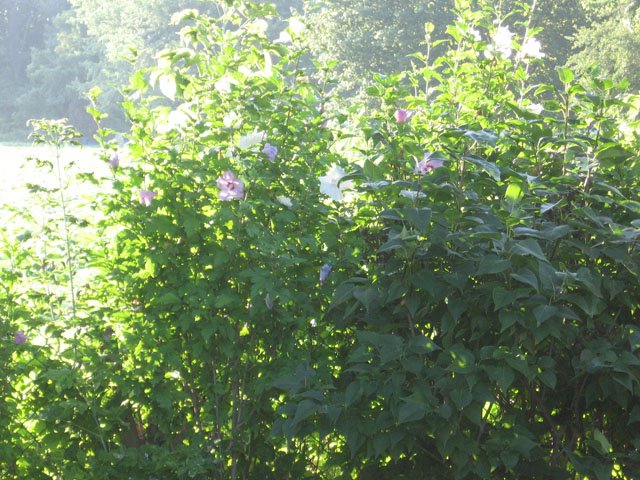
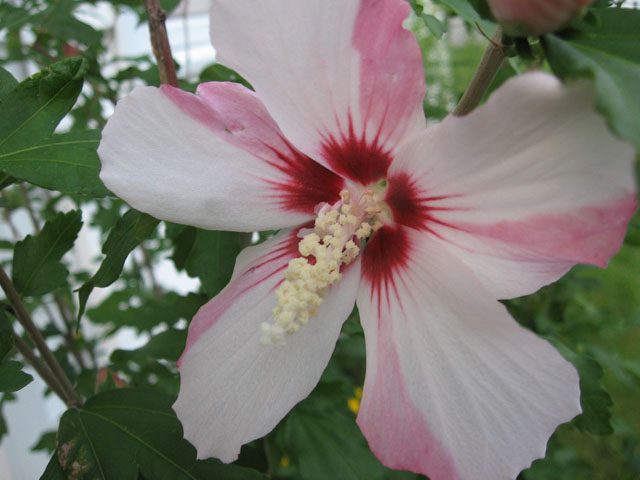
Rose of Sharon (Hibiscus syriacus) is a true beauty. The name is a little confusing as it isn't a rose at all, it is really a Hibiscus. It is a medium sized ornamental bush with showy blooms throughout the summer. There are several bloom colours to choose from and the blooms can be either single or double petal. The blooms attract hummingbirds, butterflies and small insects. Rose of Sharon is a popular hedging here and it is easy to see why. The plant blooms on new growth. Pruning is best done in early spring in our area. Other than that the plant is low maintenance and will even tolerate neglect.

Rose of Sharon Bushes

When we bought this house we discovered an overgrown stand of Rose of Sharon along with purple lilacs. All of the gardens were overgrown and very neglected. The former vegetable garden was downright horrid! Our intentions were to rip out everything in that area and start fresh using raised beds. Only by careful observation were the Rose of Sharron was discovered. The rose of sharron were sadly neglected and overgrown with brush that needed to be cut out so we trimmed them right down. In the same area there naked lady lilies, lilacs, a ton of unidentified weeds, wild grapes, and poison ivy. We have slowly worked to irradicate the harmful while keeping what we want. The Rose of Sharron have responded by giving us blooms and healthy growth but it will be a year or two before they are as we want them. I think they are a beautiful part of our gardens. They provide a wonderful backdrop for the vegetable garden!

Hibiscus syriacus 'Aphrodite'

Aprodite was the first to bloom for us so will always be just a little special. The bloom is a single petal pink mauve with a deep magenta eye. Within these bushes there are two box elder stumps that set up shoots. They cannot be removed without damaging the Rose of Sharon and we are leary to use any type of herbicide for fear it will damage the surrounding bushes. So we keep trimming any shoots that appear. Box elder trees are really problematic here, best described as a junk tree by many.

Hibiscus syriacus 'Diana'

Diana surprised us the second year we were here. There are two bushes mixed in with the Aprodite bushes. The bloom is single petal pure white with no eye. It is a sharp contrast to the deep green foliage of the bush. There is no possibility of separating the two cultivars or either from the lilacs so we prune and let them be. I'm planning on cross pollinating the two to see what the results are.

Hibiscus syriacus 'Blush Satin'

Blush Satin is very pretty! I love the colours on this plant. The blooms have a candy striped appearance with alternating bands of pale pink and deeper rose pink with a deep magenta eye. This bush is not in the same area as the others. We planted it in another area closer to the house after we discovered the other Rose of Sharon. It was only twig size and we had doubts it would survive. It proved us wrong! The bush is now about six feet tall and blooming well.

Happy Gardening

Garden Gnome